Chino Wood Flooring has spent more than 20 years on wood-flooring in Coronita and across the Inland Empire, and most of what we do here is bringing back, repairing or replacing floors in houses that have already lived a long time. We sand and recoat solid hardwood, install new engineered and solid floors, and rebuild stairs, with the house’s own history setting the plan rather than a stock quote.
Every job starts with a walk-through and a look at what is actually underfoot. Where the owner allows it, we pull back a corner of carpet, check the boards for cupping, crowning and board gapping, and take moisture meter readings before we talk about price. That first visit tells us whether a floor can be sanded, needs repair or is past saving.
From there the quote is written line by line: square footage for the field of the floor, stairs priced by the tread and riser, and a written cure schedule so the household knows which rooms are out of use and for how long. Dust containment is part of the plan from the start, not an add-on at the end.
Wood Floors in Coronita’s 1950s Houses
A neighborhood built mostly in one decade
Coronita’s housing stock is unusually concentrated in time. The Census Bureau’s American Community Survey 2024 five-year estimates count 801 housing units, and 359 of them, or 44.8 percent, were built between 1950 and 1959. Another 155 went up in the 1960s and 160 in the 1970s, which puts 86.6 percent of the community’s homes before 1980.
Only 14 units date from 2000 to 2009, and the survey records none built since 2010. For us that means a Coronita job is almost always a floor in an established house, with decades of wear, earlier repairs and later coverings layered on top, rather than a new build waiting on its first finish.
What an older floor usually turns out to be
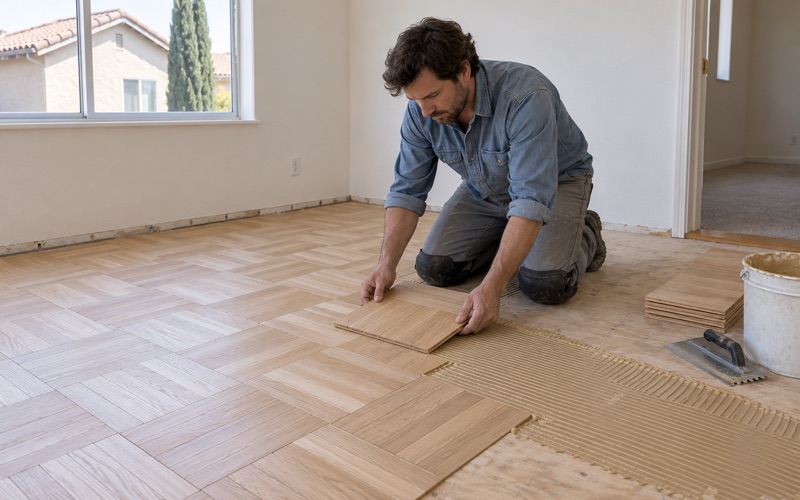
Mid-century houses often went in with solid hardwood, typically red oak or white oak in narrow tongue and groove strips, nailed down and site-finished. Many of those floors are still in place in older neighborhoods. We never assume one is there until we see it, though, because seven decades of remodeling can leave anything from intact strip oak to parquet to a plywood patch where a wall once stood.
When we do find original solid hardwood, we check how much wood remains above the tongue. A floor that has been sanded several times may have only one careful refinish left, and we would rather tell an owner that plainly than promise a deep sand the boards cannot take.
Build year and the federal lead rule
Because 86.6 percent of Coronita homes predate 1980, we confirm the build year before any sanding starts. The EPA’s Renovation, Repair and Painting rule reaches paint disturbed in homes built before 1978, and pulling baseboard, quarter round or door casing to sand a floor edge can disturb painted trim.
When a house falls under the rule, we plan the trim removal, containment and cleanup around it from the first day instead of discovering it halfway through the job. Owners get that plan in writing along with the floor quote, so nothing about the process comes as a surprise.
Looking for wood-flooring closer to Pomona? See Wood-Flooring in Pomona.
A Riverside County Community Inside Corona
Who the local government is
Coronita is an unincorporated community of Riverside County, a census-designated place covering 0.6 square miles that is mostly surrounded by the City of Corona. The county, not Corona, is the local government here. That matters to anyone planning home improvement work, because questions about local rules for a Coronita address go to Riverside County rather than to Corona City Hall.
The community is easy to miss from the street. Its ZIP code is 92882, and the 2020 census counted 2,639 residents. Coronita first appeared as a census-designated place in the 2010 census, and its name is Spanish for ‘small crown,’ a fitting label for a small pocket of county land.
Septic, and what the sewer plan says
Coronita’s homes are on septic. The City of Corona’s 2026 Sewer Master Plan Update Initial Study says so directly: “The communities of Coronita and El Cerrito are currently on septic.” The same document notes that the city may eventually provide sewer service to these areas, but that there is currently no plan to annex them into the city’s boundary.
We mention it because it is one of the clearest markers of Coronita’s status as county land inside another city’s footprint. It is a fact about the place, not about floors, and it changes nothing in how we sand, finish or install. What it does remind an owner is that the county is the government to call about the house.
Older Floors Under Carpet and Vinyl
What turns up when the carpet comes out
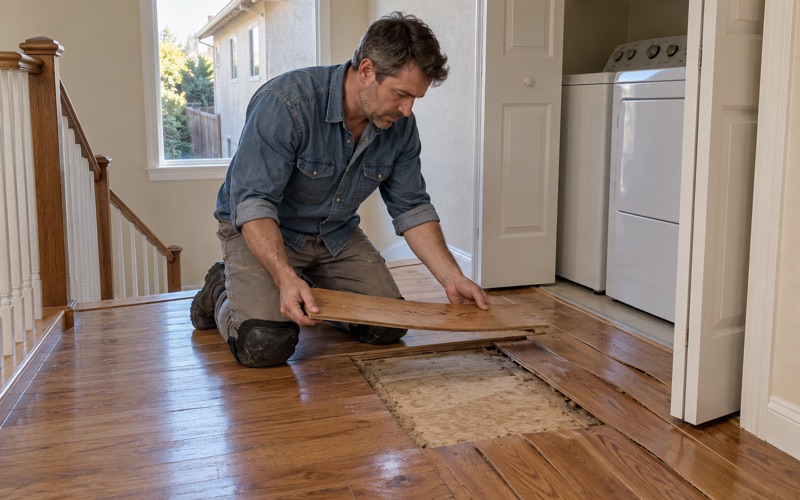
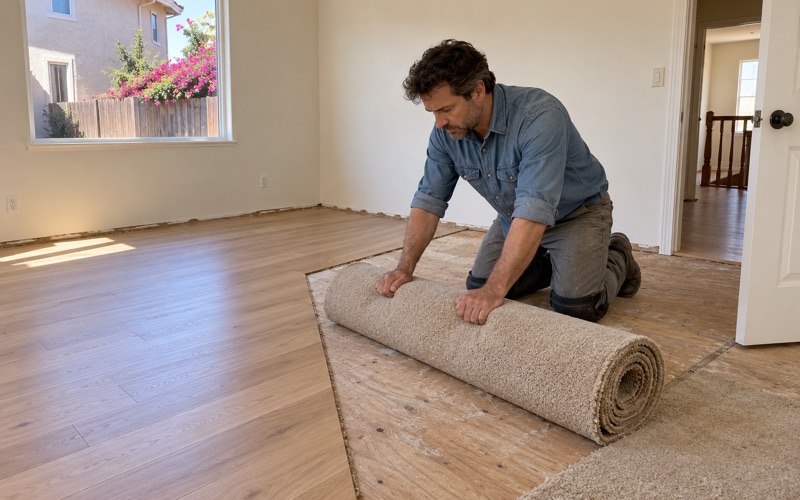
In houses of this era, carpet was frequently laid right over the original hardwood. When we lift it, the usual finds are tack strip nailed through the boards around the room’s edge, staple holes from the carpet pad, and a finish that has yellowed or worn through along old traffic paths. Most of that is repairable: tack strip holes take wood filler, and a proper grit sequence removes staining that sits in the finish rather than the wood.
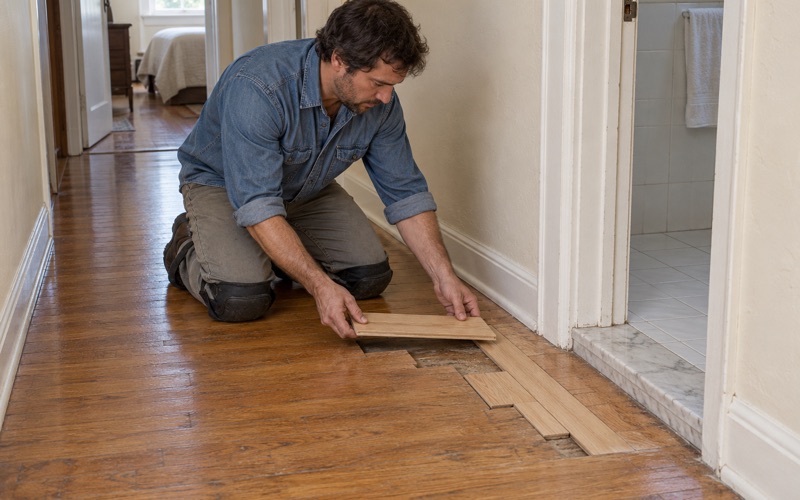
Deeper damage calls for a different plan. Pet urine stains that have soaked into the grain often turn dark and will not sand out, so those boards are cut out and replaced with matching species and width woven into the surrounding floor. Done carefully, the repair disappears once the whole room is sanded and finished together.
Vinyl, tile and old adhesives
Sheet vinyl, vinyl tile and ceramic tile show up in kitchens, baths and entries of older homes, sometimes glued straight to the subfloor and sometimes over an earlier floor. Older resilient flooring can sit on black mastic, an adhesive we identify before anyone grinds or scrapes it. An unknown layer gets tested, not torn into.
Once we know what each layer is, we can tell an owner whether the new floor goes over a clean subfloor, needs leveling first, or needs an older covering removed. That answer drives both the price and the schedule, so we settle it before anything is ordered.
Insects, hollow spots and past repairs
Older wood also gets checked for insect activity. Drywood termite frass, the small pellets that collect below infested wood, and the tiny exit holes left by powderpost beetle are both things we look for along baseboards and in exposed boards before committing to a refinish.
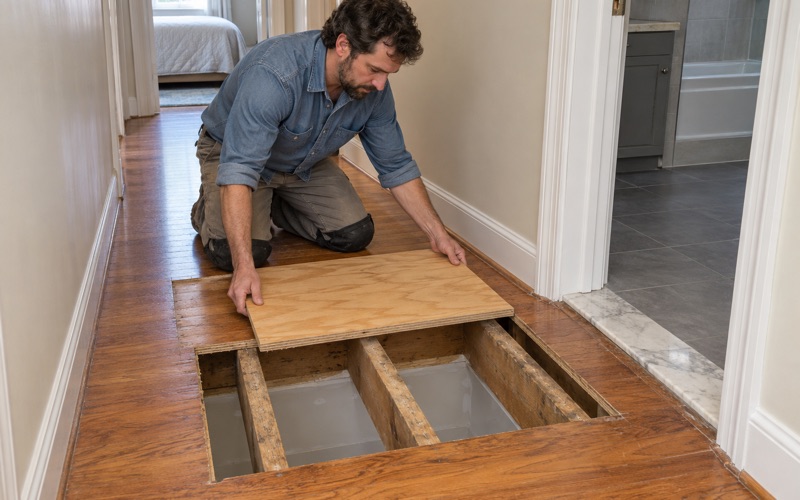
We also listen for hollow spots and feel for loose boards underfoot, which can point to earlier patch jobs, failed fasteners or subfloor trouble. Anything that looks structural is flagged to the owner before sanding begins, not after the finish is down.
Refinish, Replace and Plan Around a Lived-In Home
When a refinish makes sense
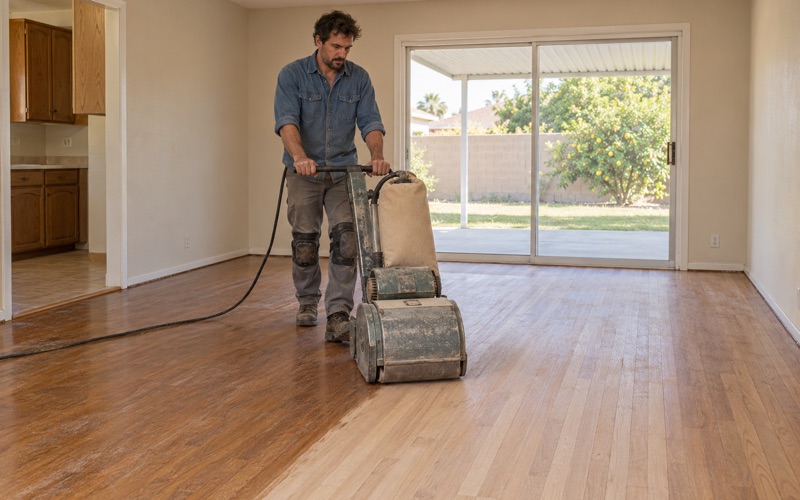
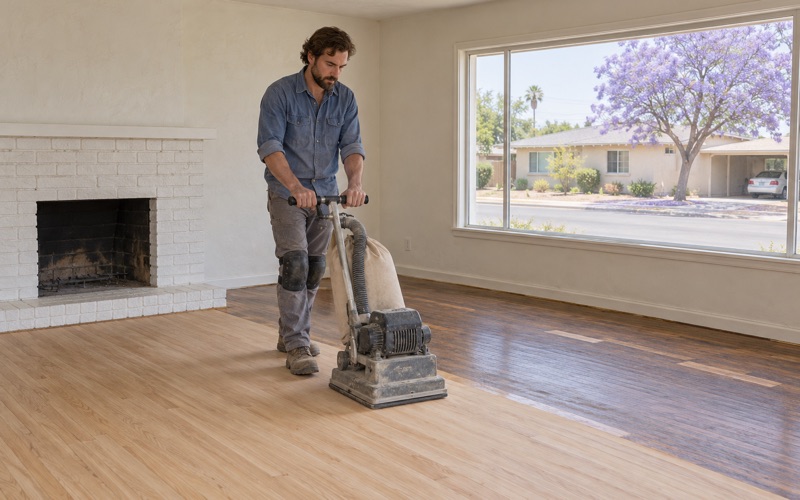
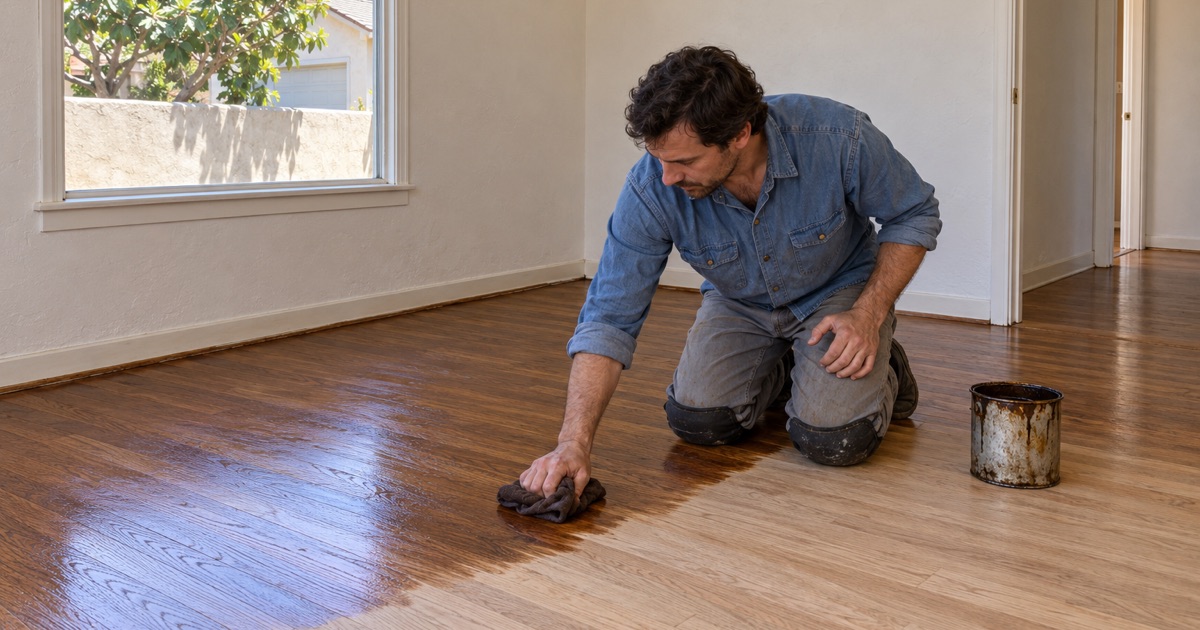
If the original solid hardwood has enough wood left and the damage is at the surface, a full sand and refinish is usually the best value in a house like this. We work through a drum sander and orbital sander grit sequence, trowel fill where the floor calls for it, and water pop the grain before a floor stain so the color takes evenly.
We treat Coronita as part of the South Coast Air Quality Management District, so SCAQMD Rule 1113’s wood coatings limit decides which finishes we use. Waterborne polyurethane, oil-modified polyurethane and hardwax oil all have compliant options, and we match the sheen level to how each room is used. For a floor that is sound but dull, a screen and recoat with a buffer can restore the finish without removing wood.
When replacement is the better call
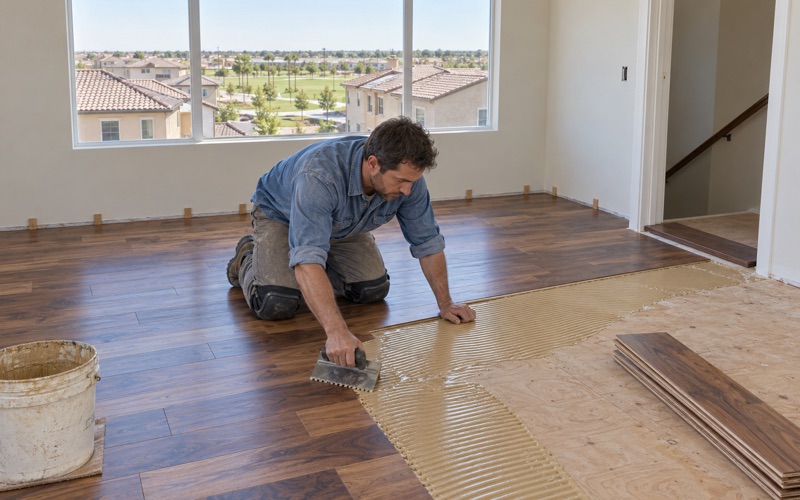
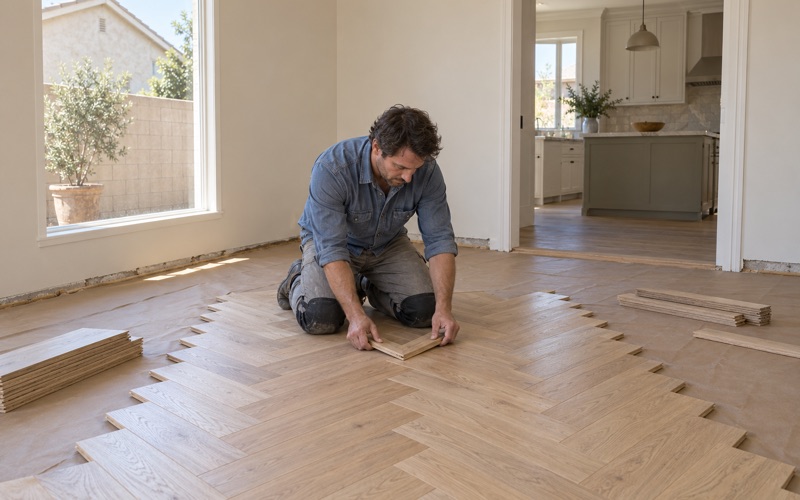
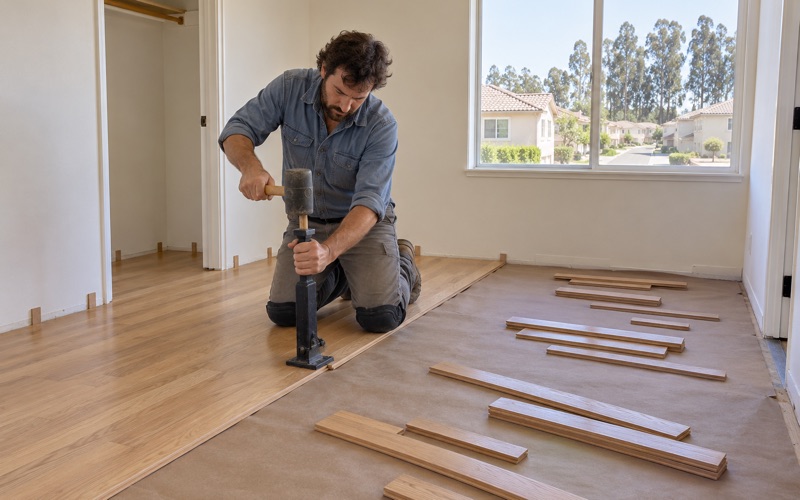
Replacement makes sense when boards are too thin to sand again, when water or pet damage covers too much of a room, or when an owner wants a different look such as wide plank white oak, hickory or a herringbone pattern. We compare solid hardwood against engineered flooring with a plywood core or HDF core, and we measure and explain the engineered wear layer so the owner knows how many future refinishes each option allows.
Where water is part of the story, we confirm the leak source and take moisture readings before replacing a single board. If an insurance claim is involved, we document the damage room by room for the adjuster, which keeps the repair scope and the claim describing the same floor.
Working around a household that lives there
The same census survey counts 753 occupied homes in Coronita, and 648 of them, or 86.1 percent, are owner-occupied. Every one of those owner households lives in a detached house. Corona’s sewer plan likewise describes Coronita as predominantly residential, with four small commercial parcels inside its boundary.
That means we are nearly always working for the person who lives in the house and will live with the floor. We set up dust containment around the work area, hand over a written cure schedule showing when rooms can take foot traffic and furniture again, and sequence rooms so a kitchen or bedroom stays usable where the layout allows.
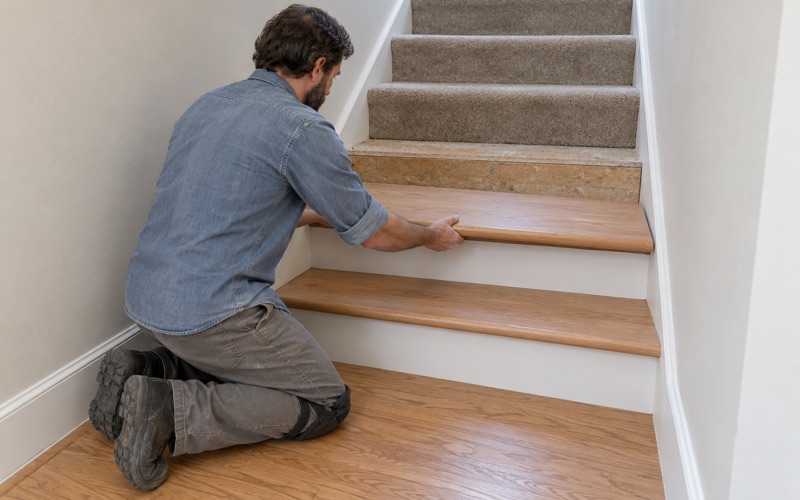
Stairs are quoted on their own, by the tread and riser, with stair nosing and risers matched to the new or refinished floor. For a Coronita owner weighing a project, a first visit to look at the floor and confirm the build year is the practical place to start.
- 20+ Years of Wood Flooring
- Slab Moisture Tested First
- Free Written Estimates