
Chino Wood Flooring installs herringbone wood floors in Chino, CA, laying the pattern in solid and engineered hardwood for entries, dining rooms, living spaces and whole ground floors, serving surrounding cities including Eastvale, Chino Hills, Ontario, Montclair and Norco. With more than 20 years of wood floor work behind us, we treat herringbone as the precise layout job it is.
A herringbone floor is only as good as its starting line. Every board depends on the one before it, so a small error at the center becomes a visible wander by the far wall. We lay out the pattern on the subfloor before the first board goes down, and check it as the floor grows.
The same care applies underneath. Most homes here sit on concrete slabs, and a pattern floor shows every high spot and every failed bond, so we test and flatten the slab before gluing anything to it.
Herringbone and Chevron Patterns
Classic Herringbone
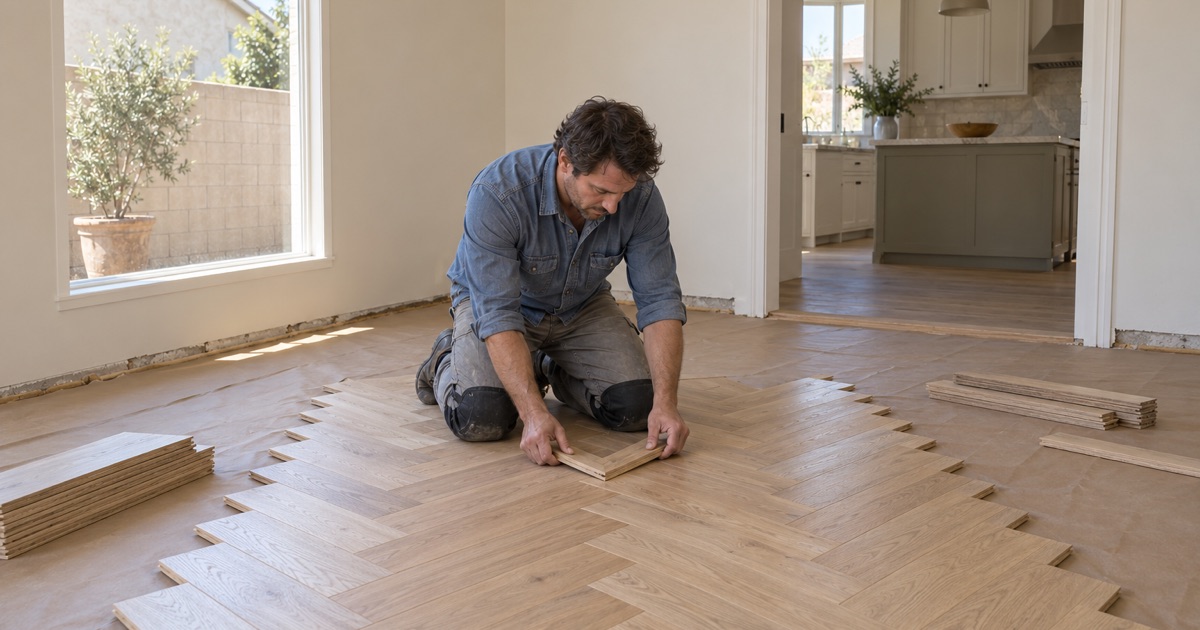
Herringbone boards are rectangles with square-cut ends, laid so each board’s end butts against the side of its neighbor. The result is a staggered zigzag with a lot of movement. Boards come in left and right versions in most engineered products, and the pattern needs both in equal numbers.
Board size changes the look dramatically. Short, narrow boards give a traditional, busy pattern, while longer and wider boards give a bolder, calmer floor that suits larger rooms.
Chevron
Chevron boards are cut at an angle so their ends meet in a clean point down the center line, forming a continuous V. It looks more formal and linear than herringbone. Because the ends are angled at the factory, chevron is a separate product and must be chosen before ordering.
Chevron usually reads best running down the length of a hallway or long living space, where the points lead the eye through the room. In a squarer room, herringbone often looks more natural. We sketch both on your plan so you can see which direction and pattern suits the space.
Double and Borders
Variations include double herringbone, which pairs two boards side by side, and herringbone framed by a border of straight boards. A border helps a pattern end cleanly at the walls and can frame an entry or dining room. We sketch the options on your floor plan so you can see where each would end.
Choosing Wood for a Herringbone Floor
Solid or Engineered Herringbone
Solid herringbone is milled from a single piece of wood and is typically nailed or glued to a wood subfloor. Engineered herringbone has a real wood wear layer over a plywood core and is the usual choice on a concrete slab. Both can look identical once installed; the subfloor and the wear layer decide which suits your home.
Pattern floors also use more material than straight-lay floors, because every wall and doorway takes angled cuts. We order extra to cover that waste and keep spare boards for future repairs, which matters more for herringbone than for plank, since matching a discontinued pattern board later is difficult.
Species and Cut
White oak is the most common herringbone species because its even grain and neutral color show the pattern well. Red oak adds warmth and stronger grain, and hickory adds a rustic, high-contrast look. Rift sawn and quartersawn oak give a straighter, calmer figure that lets the pattern lead.
Prefinished or Site-Finished
Prefinished herringbone arrives with its finish applied and is ready once installed. Site-finished herringbone is sanded flat and finished in place, which gives the smoothest surface across all the joints and your choice of stain and sheen level. On site-finished floors, we use finishes within the South Coast AQMD wood coatings limit.
Installing Herringbone
Layout From the Center
We find the center line of the room or the main sight line from the entry and snap chalk lines to guide the pattern. The first rows are set against a straightedge or temporary guide board. We check squareness often, because a pattern that drifts early is impossible to hide later.
We also plan where the pattern will meet each wall, doorway and transition. Ending with thin slivers at a doorway looks accidental, so we adjust the start point to land full or near-full boards at the most visible edges.
Glue-Down on a Slab
On concrete, we test for moisture and record the reading against the NWFA guideline, grind or fill the slab flat, and glue the boards with urethane flooring adhesive. Herringbone cannot be floated in the usual way, so the bond has to be right. Poor adhesive coverage leaves hollow spots that are more noticeable in a pattern floor.
Flatness is judged more strictly for herringbone than for plank. Short boards bridge less of a dip, so a low spot a long plank would span shows up as a rocking board or an open joint. We check the slab with a long straightedge in several directions and fill or grind until it meets the manufacturer’s tolerance.
Nail-Down on Wood Subfloors
Over plywood, solid herringbone can be glued and nailed with a flooring nailer, or glued alone depending on the product. We check the subfloor for flatness and squeaks first. The pattern’s short boards need secure fastening at each end to keep joints tight.
Living With a Herringbone Floor
Transitions and Trim
Where the pattern meets tile, carpet or a straight-lay floor, we use a border board, a flush threshold, or a T-molding that matches the finish. Baseboard or quarter round covers the expansion gap at the walls. Clean transitions are what make a pattern floor look planned.
Where herringbone flows from one room into the next through a doorway, we decide early whether the pattern continues straight through or stops at a border. Carrying the pattern through looks seamless but requires the layout lines to align between rooms, which we plan before installing the first board.
Refinishing Later
A solid or thick-veneer herringbone floor can be sanded and refinished in the future. Because the grain changes direction with every board, we finish with an orbital sander to remove cross-grain scratches. Choosing a thicker wear layer now gives you more refinishes later.
Everyday Care
Felt pads under furniture, walk-off mats at exterior doors and a damp, not wet, mop keep the finish looking new. Grit is the main enemy of a floor finish, and a pattern floor shows scratches from every direction. We leave care notes for your specific finish.
- 20+ Years of Wood Flooring
- Slab Moisture Tested First
- Free Written Estimates