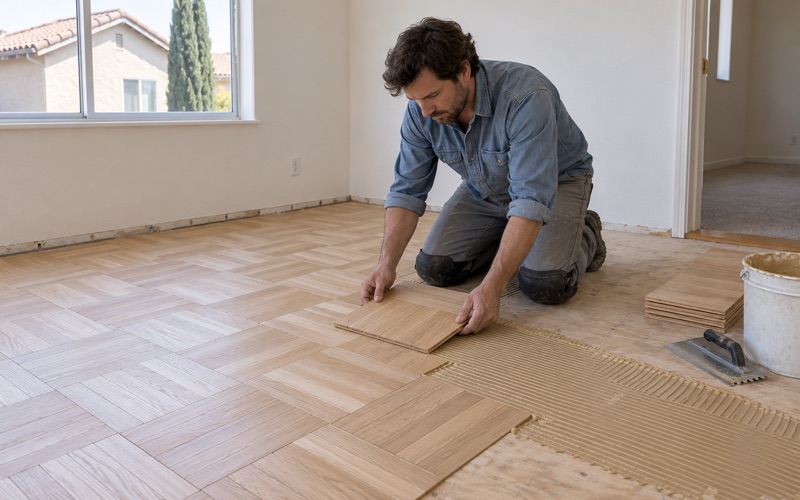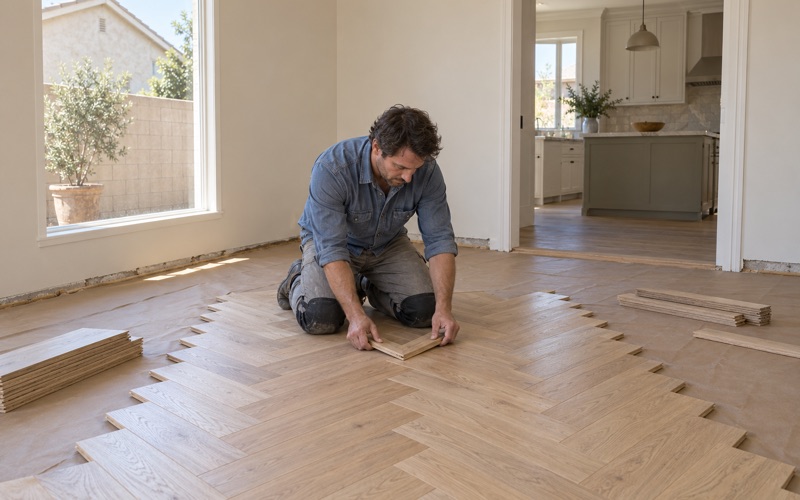
Chino Wood Flooring has handled wood-flooring in Home Gardens for owners and landlords across more than 20 years of sanding, repairing and installing hardwood. Most of our calls here fall into three groups: a tired floor that needs a full refinish, a section of boards ruined by a plumbing leak, and an older room ready for new solid hardwood or an engineered plank. Each one starts with the same visit, where we walk the rooms, read the boards with a moisture meter and ask what the house has been through.
That visit matters because the right answer depends on what is under your feet. A solid red oak floor from decades ago can usually take another sanding, while an engineered floor may have only a thin wear layer left. We measure before we promise a refinish, and we write down the readings so the plan you approve is built on numbers rather than a guess.
We also plan the job around the household. Dust containment goes up before a sander starts, and you get a written cure schedule showing when you can walk on the finish in socks, when furniture can return and when rugs can go back down. People working from home or caring for kids and pets tell us that schedule is the part they value most.
Wood Floors in Home Gardens Houses
Home Gardens is a census-designated place in the Inland Empire part of Riverside County, sitting between Corona and Riverside inside Corona’s sphere of influence. Because it is unincorporated, Riverside County is the local government rather than a city hall. For a flooring project, that mostly shapes who you call about utilities, which we cover below, but it also reflects a community with a long residential history.
Two building eras that show up often
Census figures from the ACS 2024 five-year estimates put the 1980s as the largest building decade, with 28.3 percent of housing units built between 1980 and 1989. Older homes carry real weight too: 44.5 percent of units were built before 1980, and the 1960s alone account for a large share of that. In practice, we meet a lot of houses from those two periods.
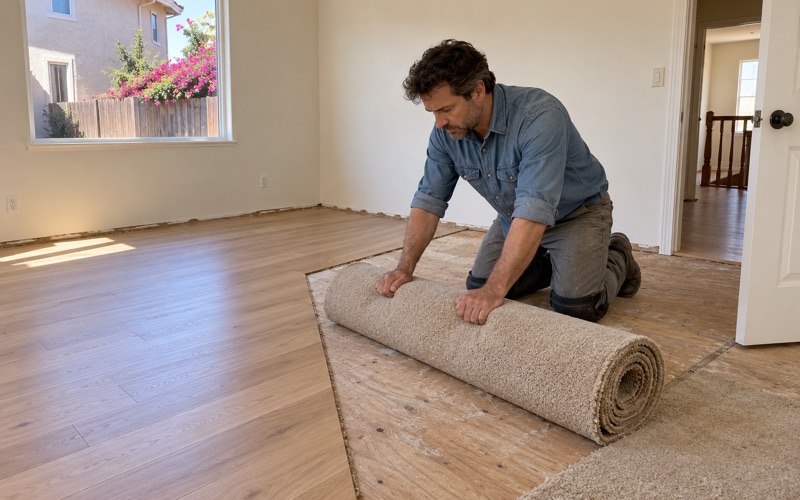
Those eras tend to bring different floors. A 1960s house may have original oak strip hidden under carpet or sheet vinyl, sometimes with old black mastic or tack strip left behind. A 1980s house is more likely to have carpet over a subfloor, or a later layer of laminate, and owners often want real wood in its place.
Owners who plan to stay
About 77.8 percent of occupied homes in Home Gardens are owner-occupied, based on ACS 2024 five-year data. Of those owner households, 81.9 percent live in a detached house. That profile matches the work we see: owners investing in a floor they expect to live on for years, not a quick cosmetic cover before a sale.
For that kind of owner, species and cut make a real difference. White oak and hickory rank high on the Janka hardness scale and hide daily wear well, while maple shows scratches more readily. Quartersawn and rift sawn boards stay more stable through seasonal swings than plain sawn stock, which is worth weighing in a wide plank layout.
Looking for wood-flooring closer to Jurupa Valley? See Jurupa Valley Wood-Flooring.
Your Water District and Your Sanitary District
One detail sets Home Gardens apart from its neighbors: water and sewer come from two local special districts, not a city utility department. When a floor project touches plumbing, or when a leak is the reason we are there, knowing which agency handles what saves time on the phone.
Home Gardens County Water District
Drinking water in the community is supplied by the Home Gardens County Water District, whose office is at 3832 N Grant St in Corona. The district publishes a Shut Off Policy and a Drought Contingency Plan on its website. If a supply line inside the house is leaking, the shutoff at your meter or the main valve is the first stop before any flooring decision.
We do not quote water quality or hardness numbers for the community, and we suggest you go to the district directly for those questions. What we can tell you is how your floor responds once water has reached it, and what needs to happen before new boards go down.
Home Gardens Sanitary District and the regional plant
Sewer service is provided by the Home Gardens Sanitary District, a member agency of the Western Riverside County Regional Wastewater Authority. The district collects roughly 600,000 gallons of wastewater a day from its service area and delivers it into the regional conveyance system for treatment. Each served property connects its drain plumbing to a lateral that runs to the property line.
The regional plant, first built in 1998, has capacity to treat 14 million gallons a day, and its treated water is discharged into the Santa Ana River. For a homeowner, the practical point is simpler: a drain or sewer problem is a question for the sanitary district and a plumber, and questions about who pays belong with them, not with your flooring contractor.
When a Plumbing Leak Reaches the Floor
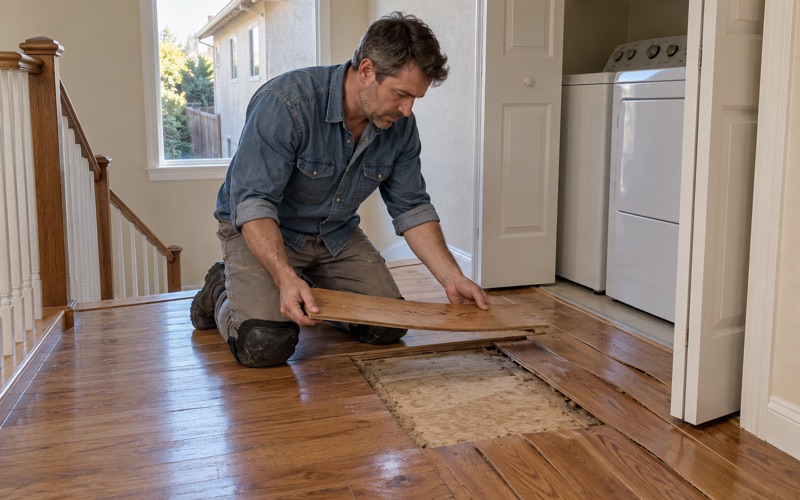
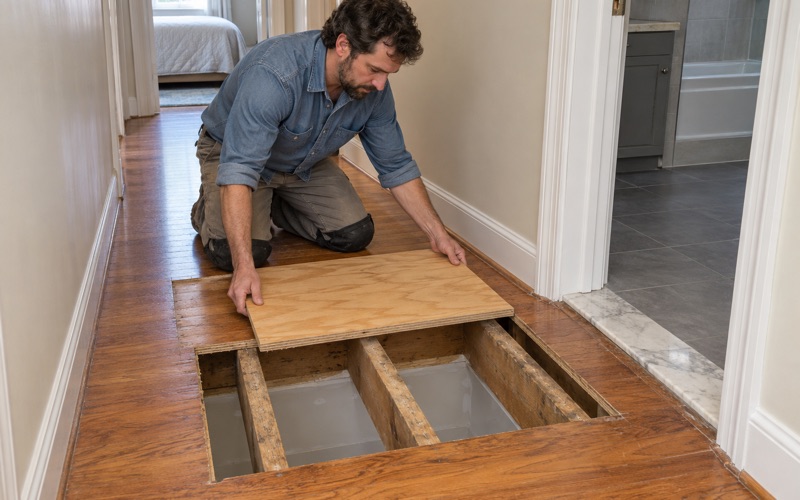
Water damage is one of the most common reasons we are called to a Home Gardens house. A dishwasher supply line, a toilet seal, a water heater or a pipe inside a wall can soak boards for days before anyone notices. By then the damage usually shows as cupping, crowning, buckling or hollow spots underfoot.
Find the source first, then read the moisture
We confirm the leak source has been repaired before replacing a single board. Putting new wood over a live leak is money lost, and a plumber’s repair note is the proof we look for. Then we take moisture meter readings across the affected area and into dry rooms, so we know how far the water traveled and what the normal reading is for your house.
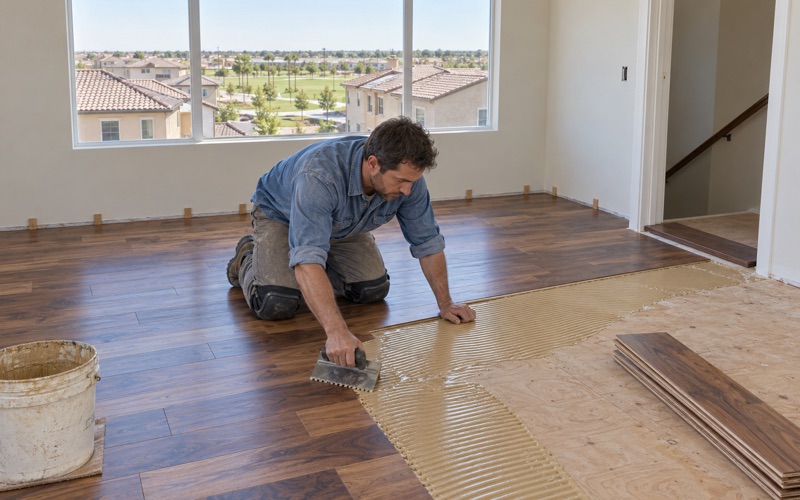
If a room sits on concrete and a slab leak is suspected, the plumber’s diagnosis comes before anything else. Once the slab has been repaired and dried, we test it again before any glue-down installation, recording the result against the NWFA Installation Guidelines. Boards that were cupped may flatten as they dry, so we often wait and re-measure before deciding how many to replace.
Documentation for your adjuster
When a claim is involved, we document the damage room by room with photographs, moisture readings and board counts. Adjusters work from records, and a clear file keeps a repair from turning into a dispute over which rooms were wet. We do not tell you what a district or an insurer will cover; we give you the evidence to have that conversation.
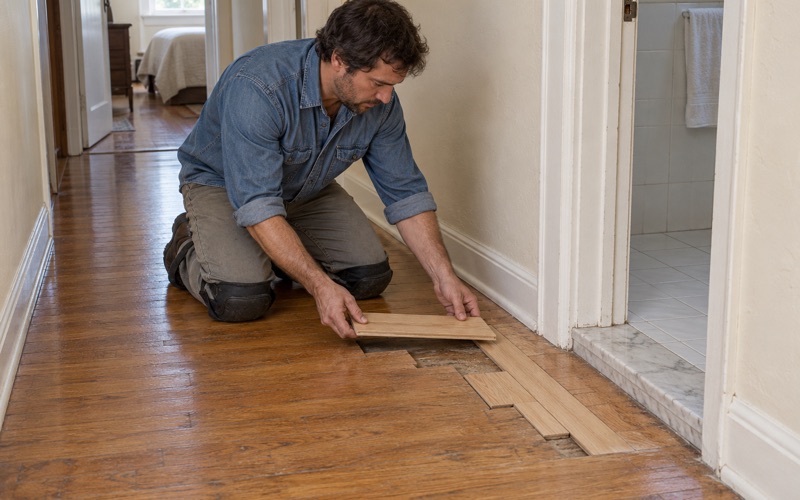
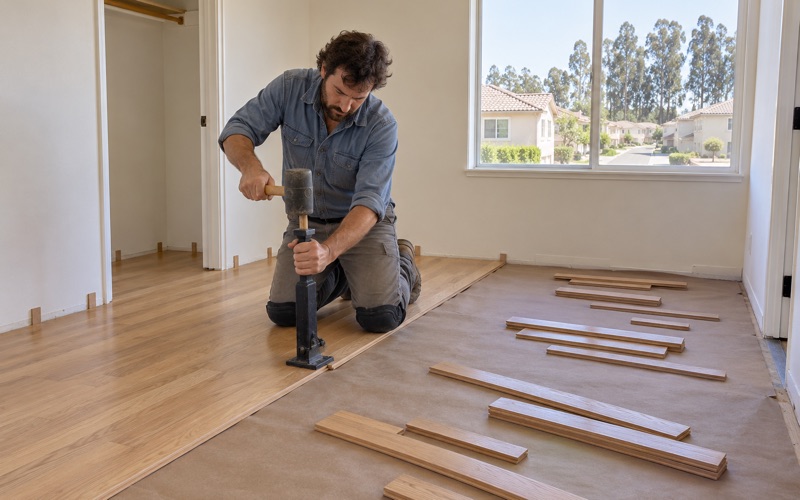
Matching repaired sections to the surrounding floor is the other half of the job. On site-finished oak, we weave new tongue and groove boards into the existing field, then sand and finish the whole room so the patch disappears. With prefinished or engineered flooring, we look for the same product or the closest available match before quoting.
Refinishing 1980s and 1960s Floors, and Rented Houses
An older floor often has more life in it than it looks. Gray, worn finish, pet urine stains and board gapping can make a room look beyond saving, yet the wood beneath is frequently sound. Our job is to tell you honestly whether a full sanding, a screen and recoat, or replacement is the right call.
Build year before the sander
We confirm the build year before any sanding starts. The EPA RRP rule applies to paint disturbed in homes built before 1978, and in an older house that can include painted baseboard, quarter round or stair risers we would touch during the work. With so many local houses built in the 1960s and earlier, this check is routine for us here rather than an exception.
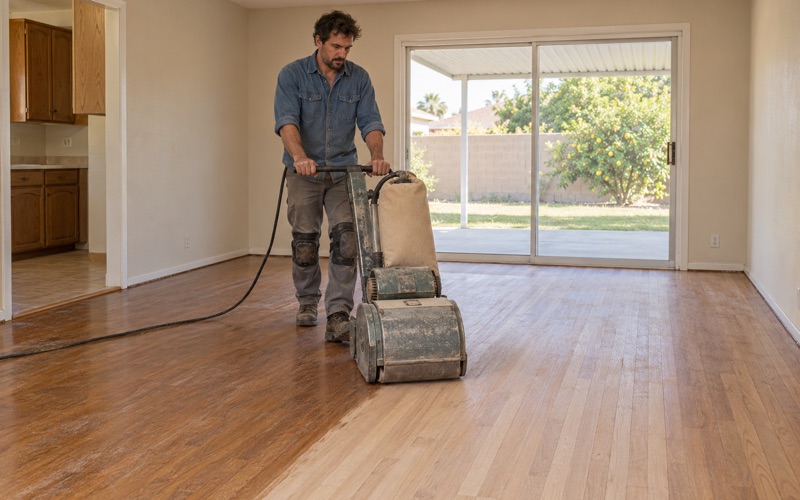
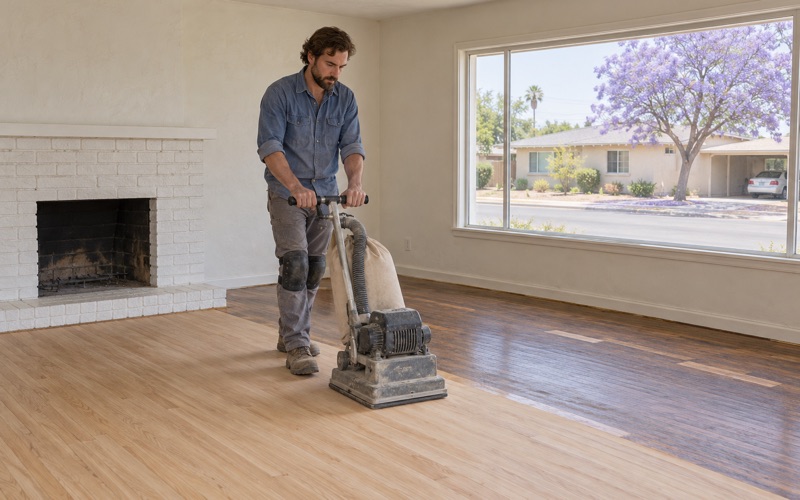
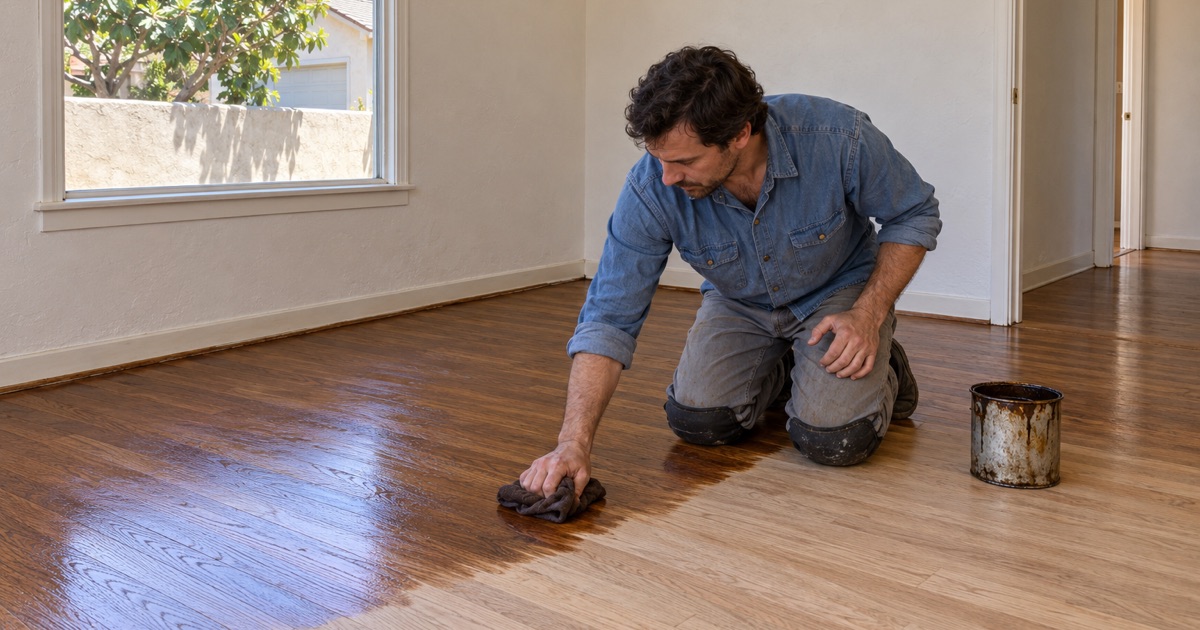
On a full refinish, we run a drum sander through a grit sequence, finish the edges with an orbital sander and use dustless sanding equipment to keep the mess contained. Gaps and small checks are handled with wood filler or trowel filling. If you want a darker floor stain, water popping opens the grain so the color takes evenly.
Choosing a finish for this air basin
Home Gardens falls within the South Coast Air Quality Management District, and SCAQMD Rule 1113 limits the wood coatings that can be used here. We choose finishes that fit that limit, most often a waterborne polyurethane, and talk through sheen level with you. Satin and matte hide wear far better than gloss in busy rooms.
For an engineered floor, we measure the engineered wear layer before promising any sanding at all. A plywood core product with a healthy top layer may take a full refinish, while a thin layer over an HDF core often calls for a buffer and recoat instead. We would rather tell you that up front than sand through the veneer.
Rented houses and turnover work
About 22.2 percent of occupied homes in the community are rented, and 48.4 percent of renter households live in a detached house. Landlords call us between tenants to refinish a floor, replace damaged boards or swap worn carpet for hardwood that holds up to turnover better. A written schedule helps them plan the vacancy around the finish cure time.
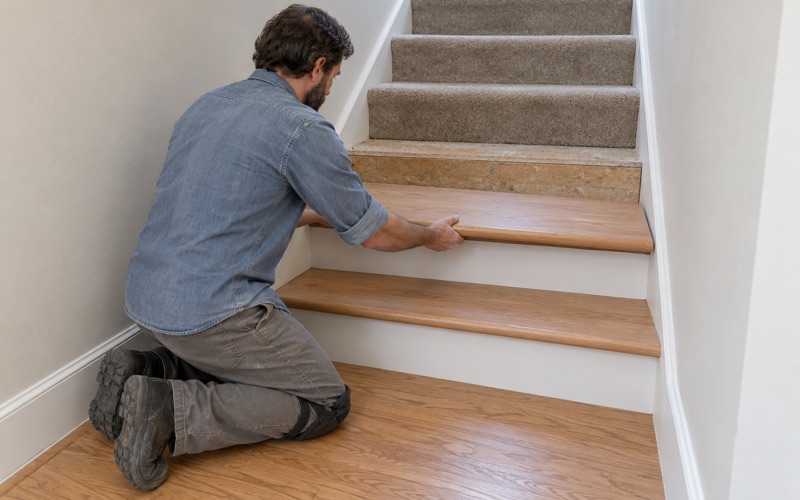
For tenants, we coordinate with the owner before any work is quoted, since the property owner makes the flooring decision. For owners of attached homes, we check association rules and approvals before flooring is ordered. Stairs, when a project includes them, are priced by the tread and riser with nosing and trim itemized, so the quote stays clear.
- 20+ Years of Wood Flooring
- Slab Moisture Tested First
- Free Written Estimates