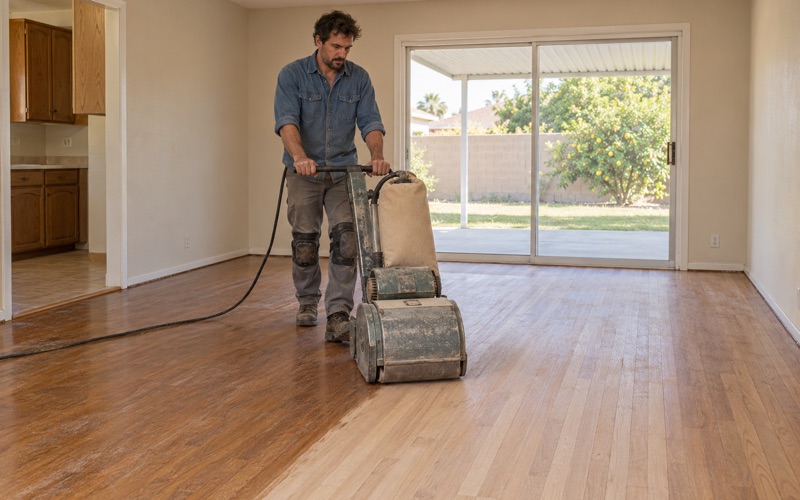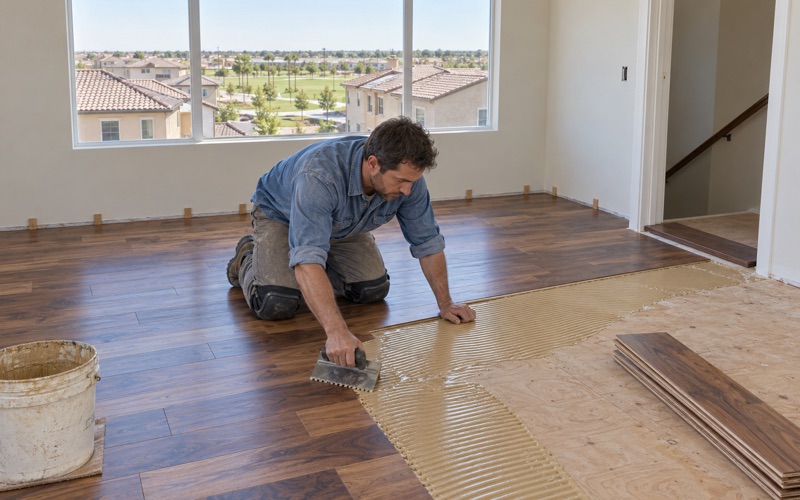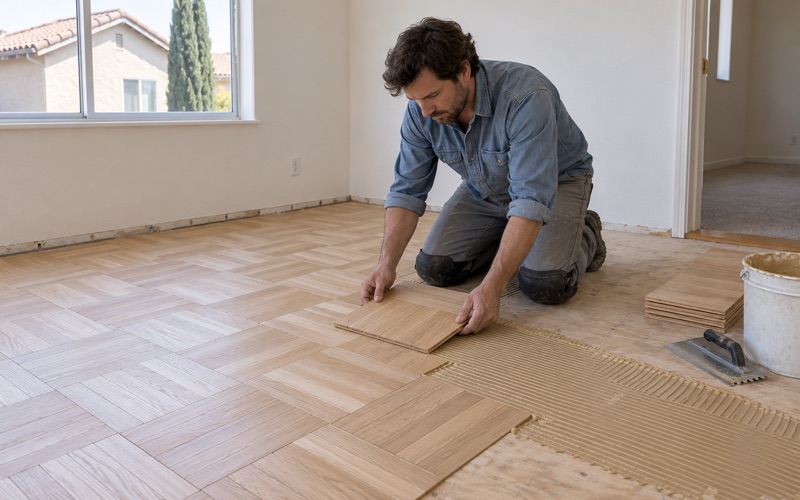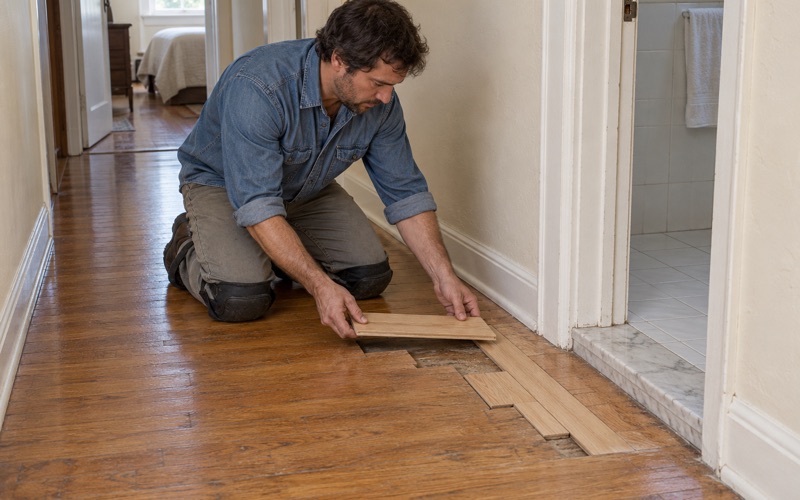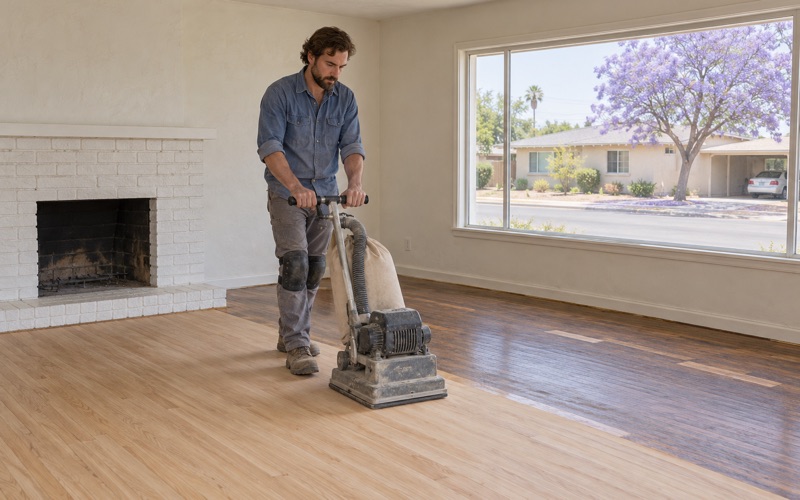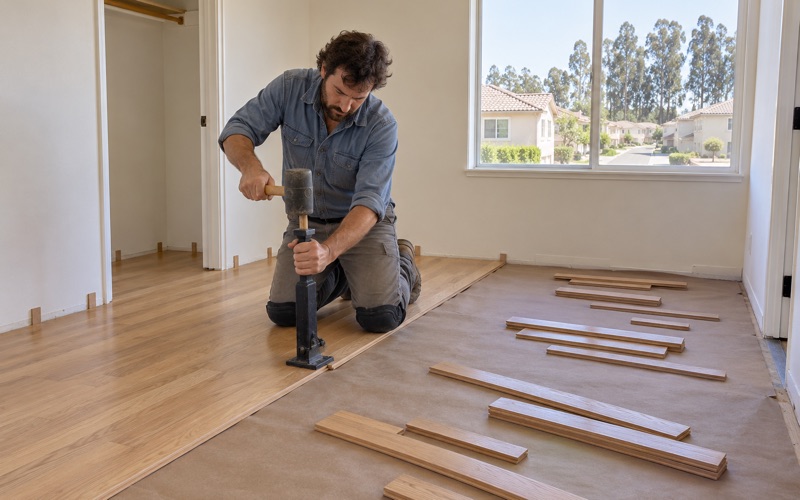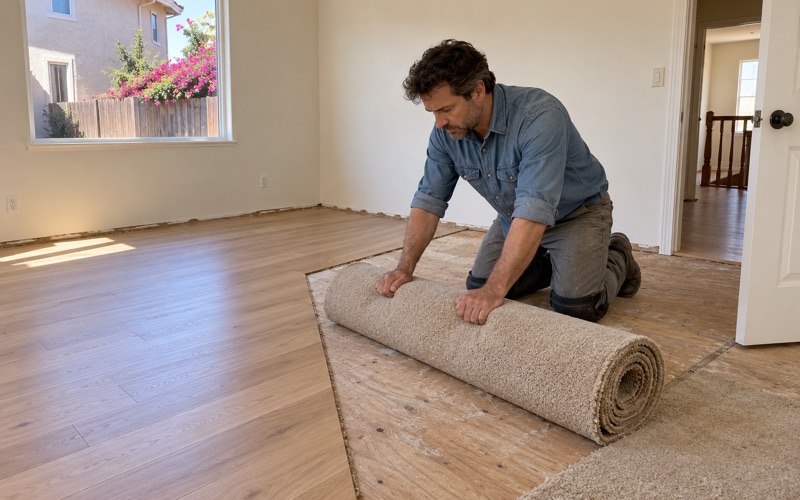
Chino Wood Flooring has spent more than 20 years on wood-flooring in Jurupa Valley and across the Inland Empire, sanding, refinishing, installing and repairing solid hardwood and engineered floors. Most calls we take here fall into two groups: an older floor that has earned a full refinish, and a floor that has taken on water and needs someone to sort out what can be saved.
Both jobs start the same way, with a close look before any number is written down. We check how the boards are fastened, what sits underneath them and whether the floor has been sanded before. On engineered flooring we measure the wear layer first, because a thin one cannot take a full sanding, and we would rather tell you that on the first visit than halfway through the job.
Water work follows its own sequence. We confirm where the water came from and take moisture readings before a single board is pulled, then record the damage room by room so an adjuster has something concrete to review. On every job, dust containment and a written cure schedule let the household plan meals, pets and bedtimes around the crew.
Wood Floors in Older Jurupa Valley Houses
The housing here skews older than many newcomers expect. American Community Survey figures (2024 five-year estimates) show 51.2 percent of homes in the city were built before 1980, and the 1980s alone account for about a fifth of the stock. That mix means we see original oak strip, 1980s plank and recent engineered floors, sometimes on the same street.
Build Year Comes Before the Sander
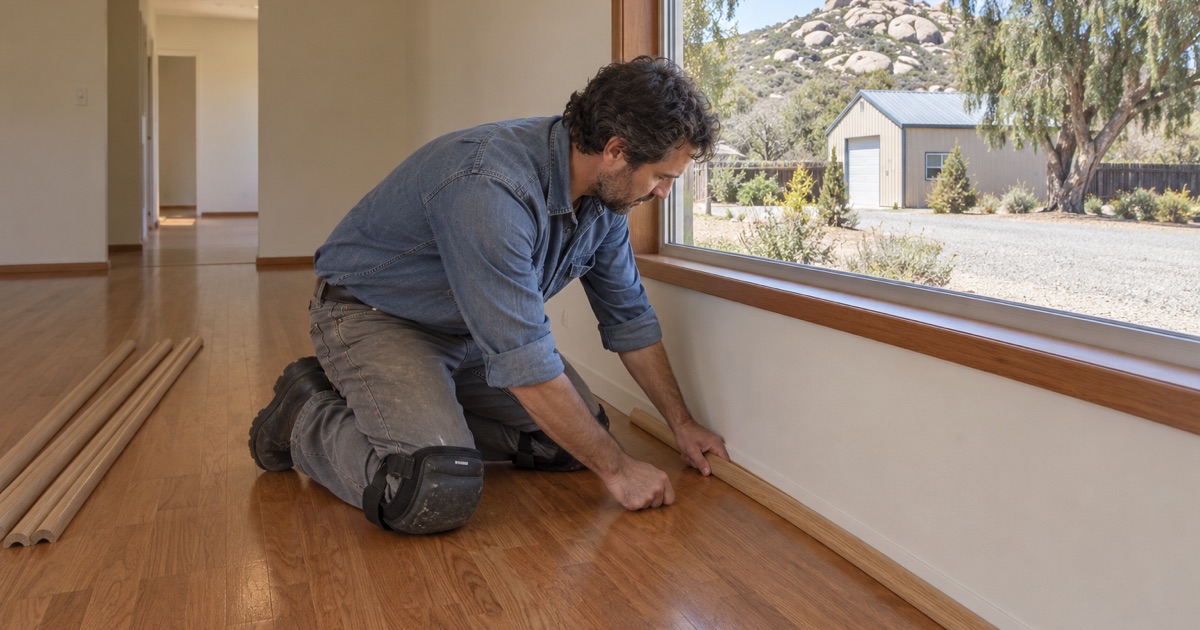
Before a drum sander touches a floor, we confirm the year the house was built. The EPA RRP rule applies to renovation that disturbs paint in homes built before 1978, and refinishing often means pulling baseboard and quarter round, scraping painted edges and sanding close to trim. The build date decides how that part of the job is set up.
In a house of that age we contain the work area, protect the rooms around it and handle painted trim separately from the floor sanding itself. None of this changes how the finished floor looks. It changes how the job is staged, and that is far simpler to plan in advance than to discover partway through a project.
Reading an Older Floor Honestly
Many older floors in the area are solid red oak or white oak laid tongue and groove, and a solid board usually has several sandings left in it. We look for board gapping, cupping along exterior walls, hollow spots underfoot and old patches that used a different species. Each one says something about how the floor has lived.
We also check for drywood termite frass and powderpost beetle exit holes, which turn up in older wood throughout the region. When a floor is sound, a careful grit sequence on the drum sander and orbital sander, trowel filling where the gaps call for it and a fresh finish can bring it back. When it is not sound, we say so before quoting a refinish.
Finishes That Belong in This Air Basin
Jurupa Valley sits within the South Coast Air Quality Management District, and SCAQMD Rule 1113 sets the limits on wood coatings used here. We choose waterborne polyurethane, a compliant oil-modified polyurethane or a hardwax oil from within those limits, then match the sheen level and floor stain to how each room is actually used.
Looking for wood-flooring closer to La Verne? See Wood-Flooring in La Verne.
Living Behind the Santa Ana River Levees
A large part of the city lies along the Santa Ana River, and that river shapes how we think about floors in Jurupa Valley. According to Riverside County news coverage from August 2022, the levees on the river between Riverside and Jurupa Valley protect roughly 4,300 structures, most of them residential properties in those two cities.
The Riverside Levees Rehabilitation
That same coverage announced a four-year, $36 million project to repair and upgrade the levee system, overseen by the Riverside County Flood Control and Water Conservation District and the U.S. Army Corps of Engineers. Work was set to begin in mid-September 2022, and the most extensive modifications were planned for the Jurupa Valley side of the river.
We install and repair floors; we are not engineers, and we have not confirmed where the project stands today or how it affects any particular lot. What the project does show a homeowner is that river flooding is a risk the county has chosen to invest heavily against, which is worth keeping in mind when deciding what goes on a floor.
A River With a Long Local Record
Accounts of the March 1938 Santa Ana River flood describe water across northwest Riverside, including the Van Buren crossing at Pedley. Pedley is one of the communities, along with Rubidoux and Mira Loma, that became part of Jurupa Valley when the city incorporated on July 1, 2011. The area’s settlement history runs back to Rancho Jurupa and an 1838 Mexican land grant.
For flooring, the lesson is practical rather than alarming. A house near the river corridor benefits from materials and installation details chosen with water in mind, and from a plan for what happens after a leak or a heavy storm. We raise that conversation early instead of leaving it for the day something goes wrong.
Storm Water, Street Flooding and the Flood Maps
The river is only one of the flood sources the city names. Jurupa Valley’s Flood Preparedness page lists urban street flooding during heavy rainfall, localized drainage problems, flooding along the Santa Ana River corridor and flood control channels, flash flooding and dam-failure flooding. It also notes that the city lies downstream of Seven Oaks Dam, the Jurupa Basin and the Declez Retention Basin.
Checking Your Address
The city points residents to two tools, and both are worth ten minutes before a large flooring purchase. The FEMA National Flood Hazard Layer viewer shows mapped flood zones for a property, and the California Department of Water Resources inundation map shows areas covered by dam-failure mapping. Neither one forecasts a flood, but together they show which mapped risks apply to your address.
If your house sits inside a mapped area, that is useful input for the floor decision. It can shape how much you spend on a ground-level room, how we detail the reducer and T-molding at exterior doors, and how readily rugs and furniture can be moved. During storms, the city notes that sandbags are available at the CAL FIRE stations within its limits.
How Water Shows Up in Wood
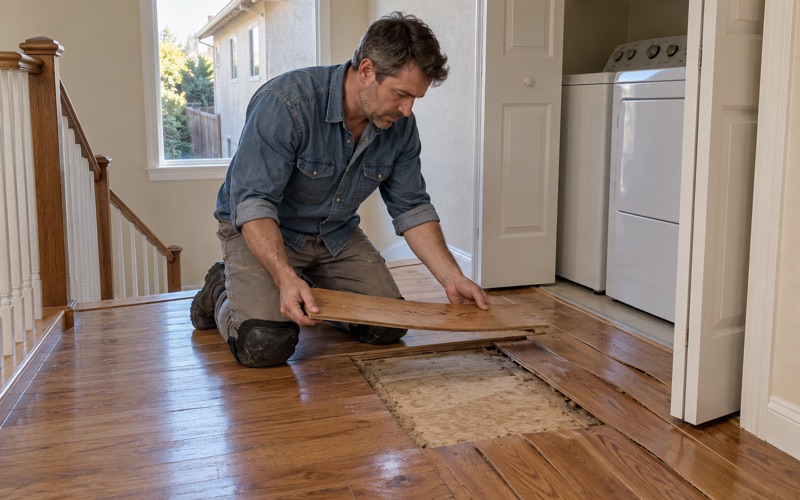
Wood records water even after the surface dries. Cupping, where the board edges rise above the centers, is the most common sign. Crowning often follows when a cupped floor is sanded flat before it has dried, and buckling, where boards lift away from the subfloor, means the moisture load was severe. Engineered boards can also show delamination between the veneer and core.
Storm water is not the only source of that damage. A slab leak, a failed supply line or a leaking dishwasher can produce exactly the same symptoms, which is why we never assume the cause from the look of the floor. Finding the real source matters, because new boards laid over an active leak simply repeat the damage within a season.
Repairing or Replacing Water-Damaged Wood
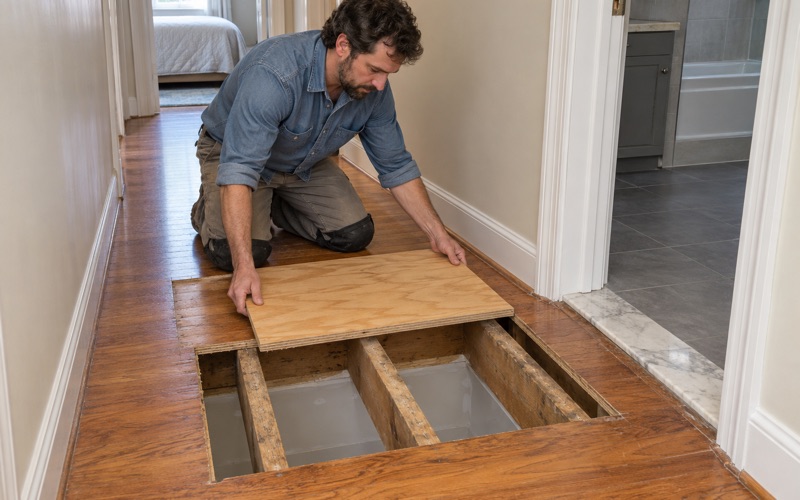
When water reaches a wood floor, the order of work decides whether the repair lasts. We confirm the leak source has been fixed, take moisture meter readings across the affected area and well beyond it, and only then decide what can be dried in place and what has to come out. Skipping any of those steps is how a repair fails twice.
Documenting the Damage for Your Claim
If you are filing an insurance claim, we record the damage room by room, with moisture readings, photographs and the extent of cupping or delamination in each space. That gives your adjuster a clear picture of every room instead of a single total. California’s claim-handling regulation at 10 CCR 2695.9 covers how property losses are repaired or replaced, and a clean record helps that conversation.
We do not decide coverage, and we cannot promise what an insurer will pay. Our part is to describe the damage accurately and lay out what the repair actually takes. That way the decision rests on measured facts rather than on a rough estimate made while the floor was still wet.
Repair, Weave In or Replace
Solid hardwood that cupped but stayed fastened often flattens as it dries, and it can then be sanded and refinished. Boards that buckled, split or stained dark usually need to be cut out and woven in with a matching species, whether red oak, white oak, hickory or maple, then sanded with the surrounding floor so the repair disappears.
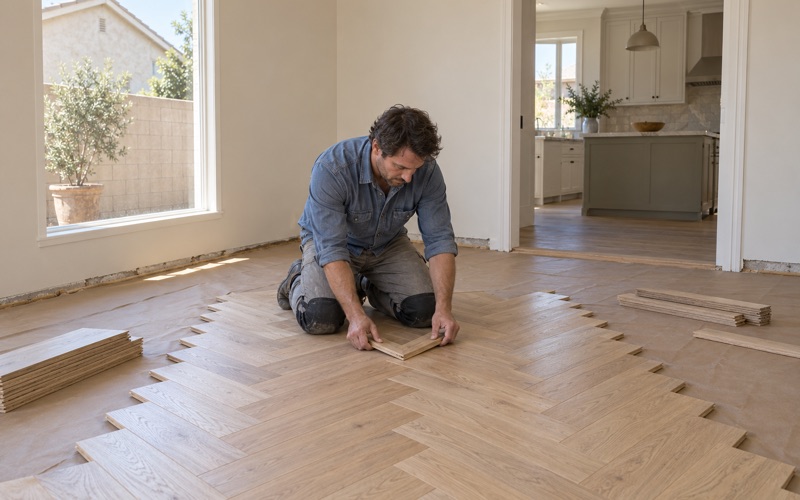
Engineered floors are less forgiving, because a delaminated plywood core or HDF core cannot be sanded back into shape. Where damage runs across a room, replacement usually makes more sense than patching. It is also a chance to reconsider the installation method, whether glue-down, nail-down or floating, for the conditions in that part of the house.
Checking What Lies Underneath
A replacement floor is only as good as what sits under it. Where there is a concrete slab, we test moisture before any engineered floor is glued down, using a calcium chloride test or in-situ relative humidity testing, and we write the reading down against the NWFA Installation Guidelines. Over a wood subfloor, we check the plywood or OSB subfloor and joists for lingering moisture.
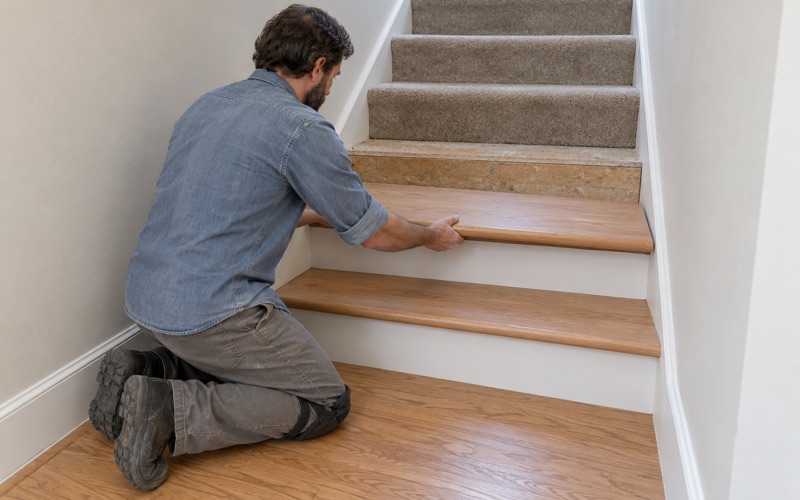
That testing can add a day or more while readings settle and new material acclimates, and it is what keeps a fresh floor from cupping the following season. Stairs are priced separately by the tread and riser rather than folded into a square-foot rate. For a townhome or condo, we check association rules and approvals before any flooring is ordered.
- 20+ Years of Wood Flooring
- Slab Moisture Tested First
- Free Written Estimates