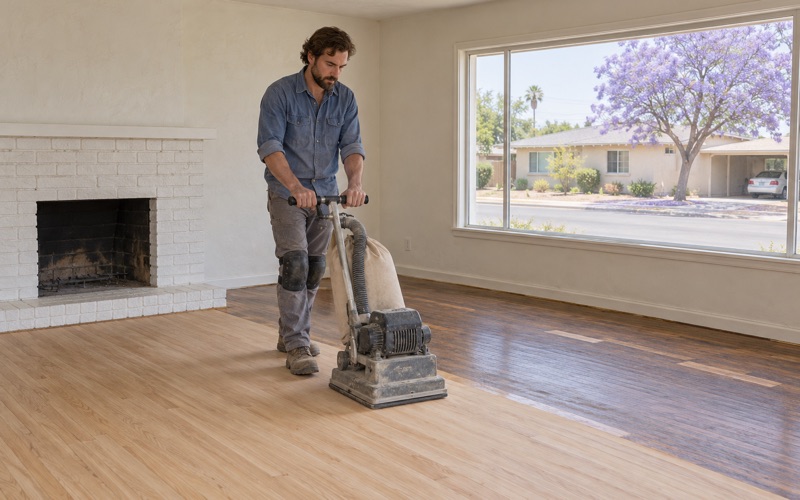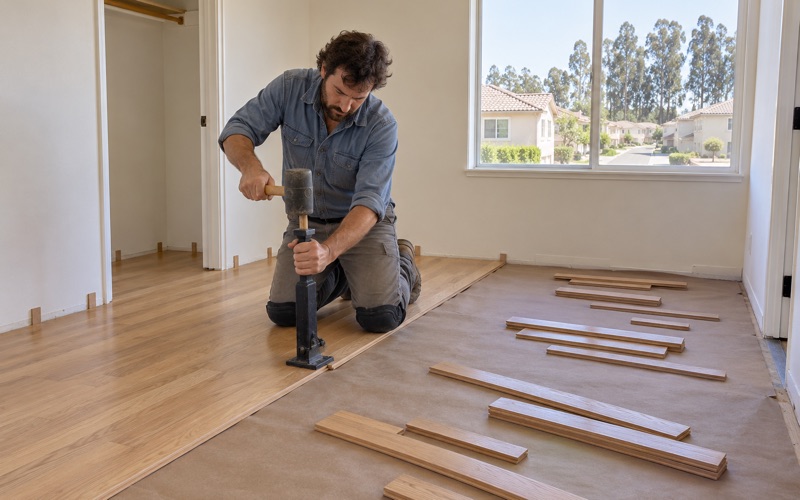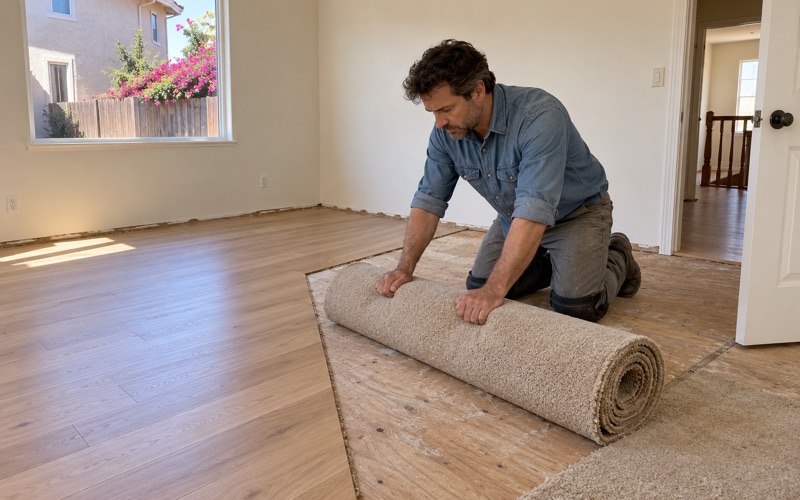
Chino Wood Flooring has handled wood-flooring in Santa Fe Springs for more than 20 years, and a steady share of that work comes from owners who rent to households holding a housing voucher. Those owners need a floor that serves a tenant well and also stands up to a federal checklist. That is a narrower question than whether a floor looks good, and we treat it that way.
A voucher inspection does not grade color, sheen or species. It looks for measurable defects: a covering that lifts, a gap that opens, a subfloor that sags or has come loose. We begin every rental job by reading the floor against those same measurements, so an owner knows which boards are a real problem and which are only cosmetic wear.
The work itself is what we do on any job: repairs, refinishing, replacement and stairs, carried out with dust containment and a written cure schedule. What changes on a voucher unit is the deadline and the documentation. The sections below walk through both, starting with who runs the program and what the standard actually measures.
Voucher Rentals and HUD’s Floor Standard
Who Runs Section 8 Here
The City of Santa Fe Springs 2021-2029 Housing Element, adopted February 8, 2022, lists Section 8 rental assistance as Program 9. The Los Angeles County Development Authority, known as LACDA, administers the program on the city’s behalf, and the city’s role is to refer eligible residents to it. The stated objective is maintaining at least the current level of assistance, 219 voucher holders.
That figure matters to a flooring contractor because each of those households lives in a unit held to a HUD physical standard. The city’s housing page makes the same point from the other side, saying Section 8 is offered by LACDA and is not administered by the City of Santa Fe Springs. Questions about a scheduled unit inspection belong with LACDA rather than city hall.
What the Standard Treats as a Floor
HUD’s NSPIRE standard titled Floor Covering and Finish, version 2.2, published June 23, 2022, defines a floor covering or finish as any surface material applied over a floor structure to provide a walking surface. Its examples run from tile and carpet to wood, vinyl, sealant, paint and stain. Hardwood flooring, stain and underlayment are all named as common components.
In practice, a solid hardwood floor, an engineered plank on a plywood core and the finish coat on top all fall inside the standard’s reach. So does the underlayment beneath a floating installation. Whatever material an owner picks, the inspection cares about how it sits and whether the structure below it is sound, not about how it was styled.
When the Standard Reaches Voucher Units
HUD has pushed the voucher compliance date back more than once. Its notice of September 30, 2025, FR-6086-N-12, set February 1, 2027 as the NSPIRE compliance date for the Housing Choice Voucher and Project-Based Voucher programs, following earlier extensions issued in 2023 and 2024. The older Housing Quality Standards are what NSPIRE is written to replace.
We plan repairs against the NSPIRE numbers because they are written down precisely and they are where the voucher programs are heading. We do not guess which standard LACDA applies to a particular inspection on a particular day. An owner who needs that answer should ask LACDA directly, and we will build the scope around whatever they say.
Looking for wood-flooring closer to La Palma? See Wood-Flooring in La Palma.
Curling, Bulging, Gaps and Loose Subfloor
The 3/4-Inch and 2-Inch Tests
Deficiency 2 in the standard covers a floor covering that is curling, buckling, bulging or separating. It is triggered when any portion curls, buckles or bulges enough to create a 3/4-inch deviation in elevation, or separates enough to leave a 2-inch horizontal gap. Either condition is rated moderate for health and safety, carries a 30-day correction and is a Fail for a voucher unit.
In a wood floor, a 3/4-inch rise is usually buckling, where boards have lifted off the subfloor after soaking up water near a dishwasher, a toilet or an exterior door. A 2-inch separation is far larger than ordinary board gapping, which tends to show as thin seasonal lines. We measure both with a straightedge and a tape before quoting, so the numbers are on paper.
Exposed Substrate in a Room
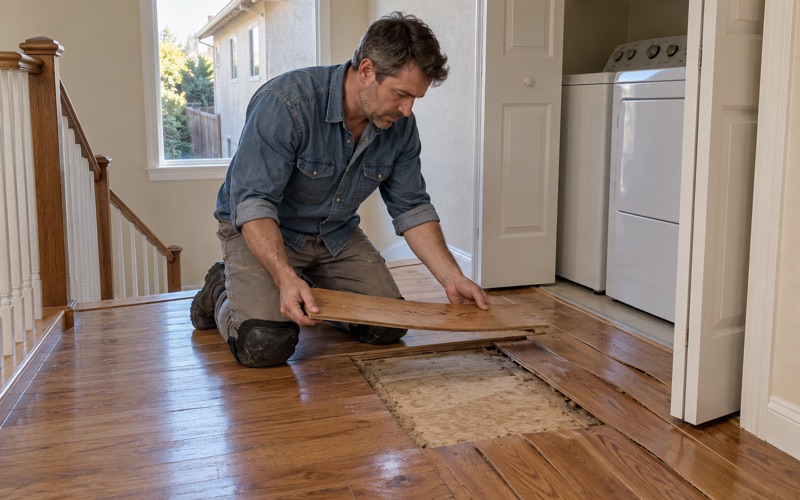
Deficiency 1 fails a room when 10 percent or more of its floor substrate area is exposed. In a rental that can mean a bedroom where carpet was pulled and never replaced, a patch of damaged boards cut out and left open, or missing flooring that sat hidden under furniture until move-out.
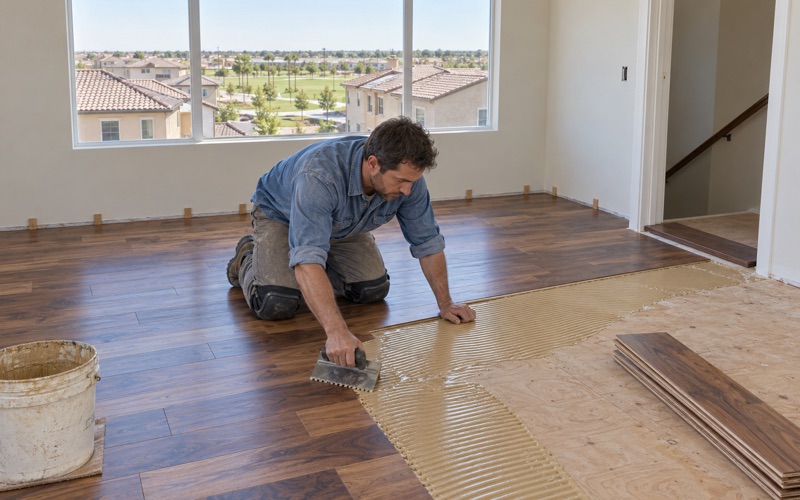
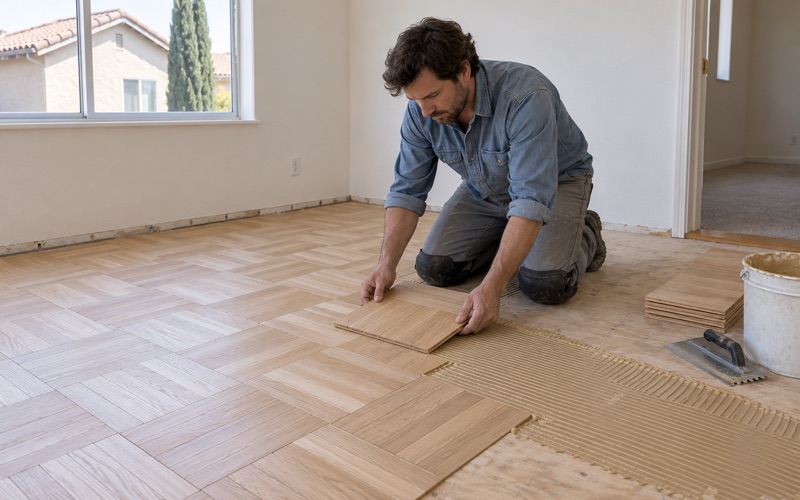
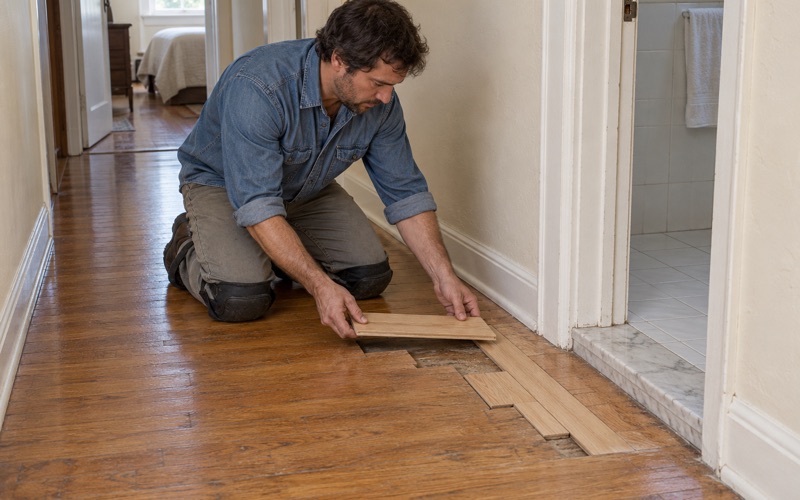
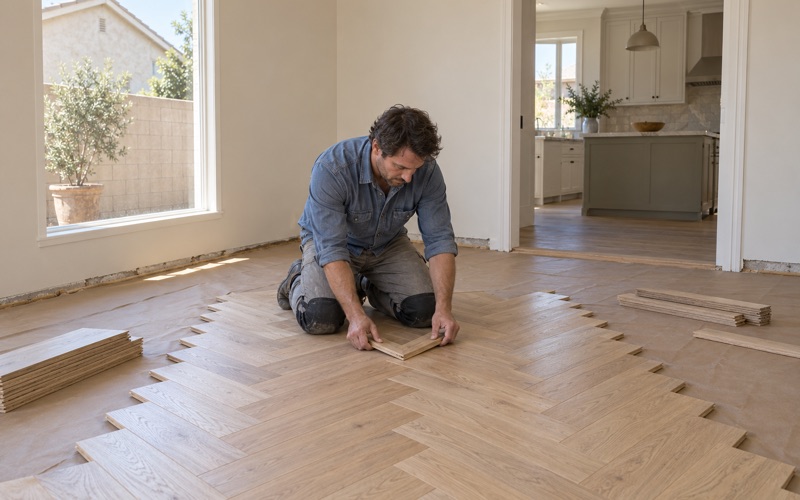
The fix is almost always new flooring rather than finish work. We match species and width where we can, weaving red oak or white oak boards into the existing field with tongue and groove joints. When a match will visibly show, we say so plainly and explain when a full-room replacement makes more sense than a patch.
Subfloor That Sags or Has Come Loose
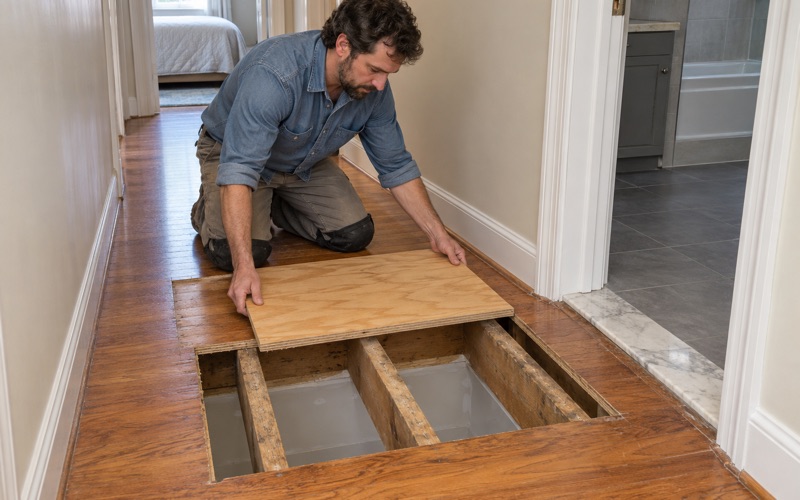
Deficiency 3 looks at the structure under the covering: a subfloor that is bowing, buckling, bulging, sagging, misaligned or not attached. It fails when more than 10 percent of the floor area in any room is not attached to the subfloor or floor joists. The standard also lists subfloor decay as a separate fourth deficiency.
Hollow spots underfoot are the early warning. A glue-down floor that sounds hollow across a wide area may have lost its bond, while a nail-down floor that moves may have loose flooring cleats or a failing subfloor. We pull a board where needed to see which, because refinishing a floor that has come loose only makes a failing surface look better for a while.
Cupped Hardwood Is Not Automatically a Failure
What HUD’s Note Says
The standard contains one line every hardwood owner should know. Its note to Deficiency 3 says some surface abnormalities may indicate that deficiency, naming lifting tiles, hardwood cupping and linoleum bubbling as examples. It then states that the surface abnormalities alone do not constitute a deficiency under this standard.
So a cupped floor, where board edges sit higher than their centers, is a reason for an inspector to look further rather than a failure in itself. What decides the outcome is whether the subfloor underneath is sound and attached. That is a separate question, and it is the one we check before recommending any sanding.
Why Boards Cup and Crown
Cupping is a moisture story. The underside of a board takes on more moisture than the face, swells and pushes the edges up. Crowning is the reverse, and it often shows up after a cupped floor was sanded flat before it had dried out. A moisture meter reading across several boards, and at the subfloor, tells us whether the source is still active.
The local housing stock makes that check worth doing carefully. Of the city’s 5,927 housing units, 2,682 were built between 1950 and 1959, and city housing staff describe much of the aging stock as needing rehabilitation, with pipe and sewer line replacements among the typical improvements. We confirm the leak source is fixed and take a moisture reading before replacing any water-damaged boards.
When Cupping Does Need Work
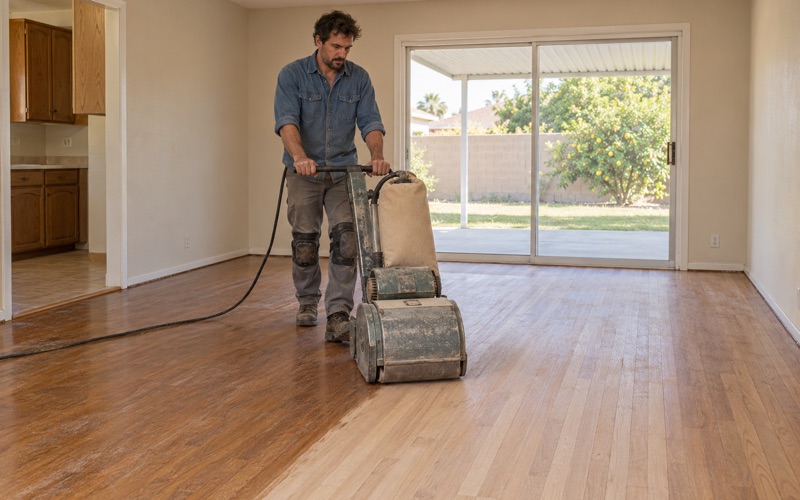
A cupped floor that has dried and settled can often be sanded flat with a drum sander and refinished. One that is still wet will keep moving, and sanding it too early is how a cupped floor becomes a crowned one. We write down the readings so an owner can show what was found and what was done.
If cupping has progressed into buckling, the picture changes. Boards lifted to a 3/4-inch rise have crossed into the measured deficiency, and the repair becomes removal and replacement of the affected section within the correction window. Catching the moisture source early is usually what keeps a cosmetic problem from becoming that bigger job.
Repairing a Voucher Unit on a 30-Day Clock
Planning Around Thirty Days
Deficiencies 1 through 3 each carry a 30-day correction timeframe. Thirty days is enough for most flooring repairs, but not if the first two weeks go to finding a contractor and waiting on material. We scope the job on the first visit, confirm stock of a matching species, and write out a schedule that shows each step.
Solid hardwood needs acclimation before installation, and a site-finished floor needs cure time before furniture returns. Prefinished boards with an aluminum oxide finish shorten that window considerably. We lay out those tradeoffs so an owner can pick the path that fits both the deadline and the tenant’s situation at home.
Working in an Occupied Home
A voucher unit is usually occupied while the work happens. We set up dust containment around the work area and hand the household a written cure schedule, so a family knows which rooms are off limits and for how long. Waterborne polyurethane cures faster and with less odor than oil-modified products, which helps when people are living in the space.
Every finish we apply is chosen to fit South Coast AQMD Rule 1113, the wood coatings limit that decides which products are legal to use in this air basin. With 69.2 percent of the city’s homes built before 1980, we confirm the build year before any sanding, because the EPA lead-safe rule reaches paint disturbed in pre-1978 homes.
Apartment Buildings and Stairs
Many renters in Santa Fe Springs live in large buildings rather than detached houses. Census figures show 840 renter households in buildings of fifty or more units, 37.3 percent of all renters. In managed buildings and townhome communities we check association or management rules before ordering material, since an approval can take longer than the repair itself.
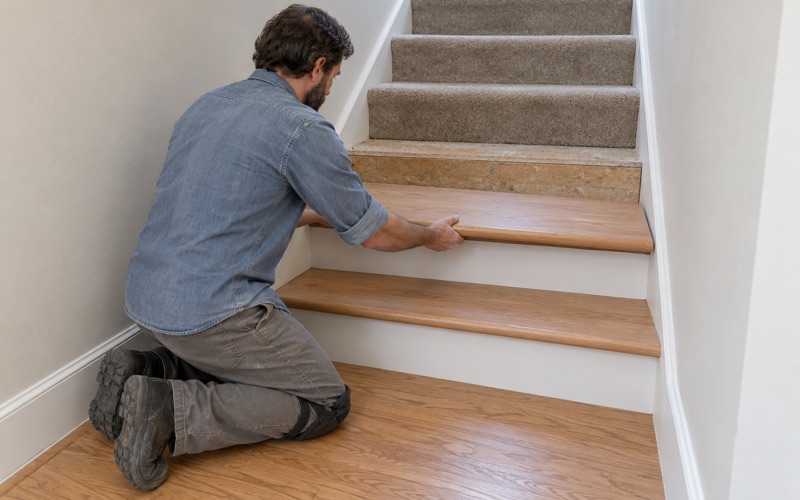
Stairs often get addressed during the same visit, whether that means a loose tread, a worn stair nosing or a scuffed riser. We quote stairs by the tread and riser rather than folding them into a square-foot price, so an owner can see exactly what the stair work costs and decide whether it fits inside the correction window.
- 20+ Years of Wood Flooring
- Slab Moisture Tested First
- Free Written Estimates