
Chino Wood Flooring handles wood floor refinishing in Chino, CA, and has done this work for more than 20 years, serving surrounding cities including Eastvale, Chino Hills, Ontario, Montclair and Norco. We sand solid oak, maple and hickory floors back to bare wood, recoat floors that are only worn, and refinish engineered floors when their veneer is thick enough to take it.
Every refinishing job starts with a walk-through and a few measurements rather than a flat quote. We check when the house was built, test the existing finish, look at the traffic lanes to see whether the wood itself is worn, and measure the veneer on any engineered floor. That tells us whether you need a full sanding or a lighter recoat, and it keeps the written estimate honest.
The work is dust-contained and scheduled in writing. Before we start, you know which rooms are closed on which days, when you can walk on each coat, and when rugs and furniture can come back.
Full Sanding Versus a Screen and Recoat
When a Screen and Recoat Is Enough
A screen and recoat uses a buffer with an abrasive screen to scuff the top layer of the existing finish, then adds one or two fresh coats. It suits a floor where the finish is dull or lightly scratched but the wood below has not been exposed. It is quicker and less expensive than a full sanding and removes very little material, which matters on older or engineered floors.
The catch is adhesion. A recoat will not bond over furniture polish, some cleaning products or certain factory finishes, so we test a small area before committing to it. When the test fails, we tell you rather than applying a coat that will peel.
When the Floor Needs Sanding to Bare Wood
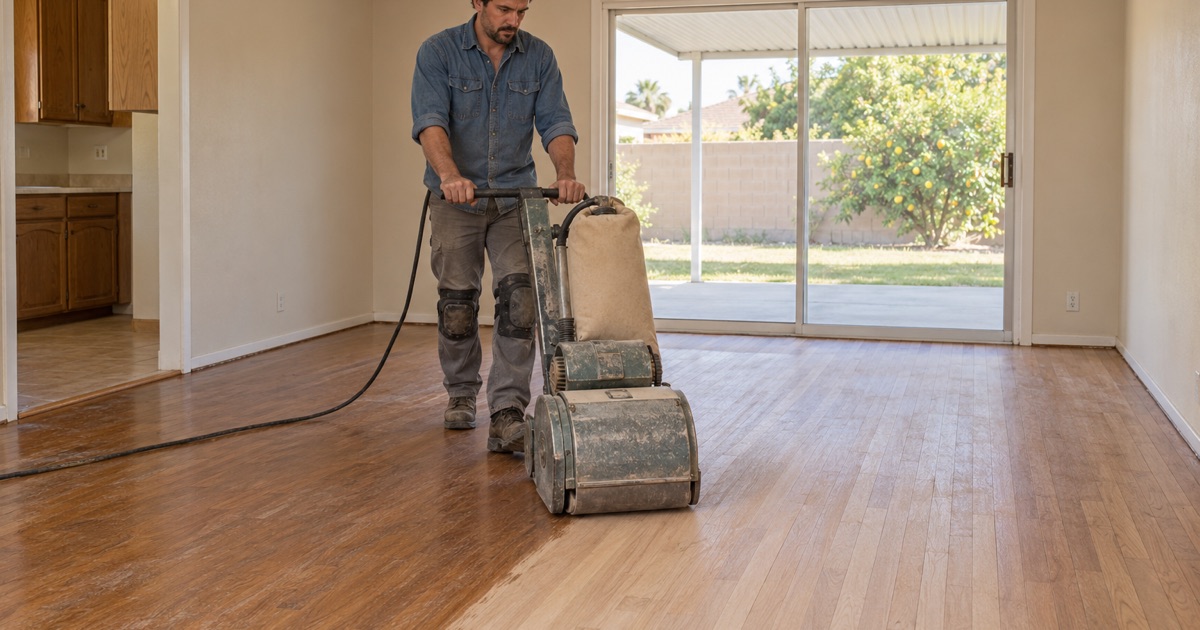
Once the finish has worn through and the wood has turned gray, or when there are deep scratches, pet stains, water marks or a color you want to change, the floor needs a full sanding. We take it down to fresh wood with a drum sander on the open floor and an orbital sander and edger along the walls. This is the only way to change the stain color or remove damage that sits in the wood itself.
A full sanding also flattens small height differences between boards, the overwood left by the original install, so the finished surface reflects light evenly instead of showing every seam. In a house with long runs from the entry through the hallway into the family room, that evenness is what makes the floor read as one continuous surface.
Refinishing Engineered Hardwood
Engineered floors have a layer of real hardwood over a plywood or HDF core, and every full sanding removes part of that layer. We measure the engineered wear layer at a floor vent or threshold before quoting. Thick veneers can take a full sanding, thin ones can take a recoat only, and some factory aluminum oxide finishes need special preparation before any new coat will bond.
When the veneer is too thin to sand, we say so on the estimate and offer the options that remain: a careful recoat with the right bonding preparation, spot replacement of worn boards, or a new floor. Promising a full sanding on a thin engineered board is how a contractor ends up showing the customer plywood halfway through the living room.
Stain, Color and Finish Choices
Floor Stain and Natural Tones
Red oak has a pink cast and strong grain, white oak is cooler and more even, and maple resists stain and can blotch without careful preparation. We lay stain samples directly on your sanded floor so you see the real color in your own light. Where a dark stain is chosen, water popping raises the grain so the color goes on evenly across the room.
Waterborne Polyurethane, Oil-Modified and Hardwax Oil
Waterborne polyurethane dries clear, keeps light woods from ambering, and has low odor, which suits occupied homes. Oil-modified polyurethane gives a warmer amber tone and a deep look on red oak. Hardwax oil soaks into the wood for a matte, natural feel and can be spot-repaired later. We explain the maintenance each one needs before you choose.
Sheen level is a separate choice from the finish chemistry. Matte and satin hide dust, paw prints and fine scratches far better than semi-gloss or gloss, which is why most households with kids or dogs pick them. We can show a sheen sample on a spare board so the choice is made by eye rather than from a brochure.
Finishes Within the Rule 1113 Limit
Chino sits inside the South Coast AQMD, where Rule 1113 limits clear wood coatings to 275 g/L of VOC. The rule applies to what a contractor uses on the job, so we only carry finishes, sealers and stains that fit within it. The 50 g/L figure some people quote is for opaque floor coatings on concrete, not for a clear hardwood finish.
Problems We Fix During Refinishing
Board Gapping and Filler
Narrow gaps between boards open and close with the seasons, while wide, permanent gaps usually point to past water damage or a subfloor problem. We fill small gaps and nail holes with wood filler, or trowel fill the whole floor when many small gaps and knots need it. Large gaps get investigated first, since filler in a moving joint just cracks out.
Pet Stains, Water Marks and Deep Scratches
Surface scratches sand out, and light water rings often do too, but dark pet urine stains and black water marks usually go deeper than a sanding can reach. We test sand the worst spots before quoting. Where a stain stays, we replace the affected boards with matching species and width, then sand and finish them with the rest of the room.
Amber, Yellowed and Faded Floors
Decades of oil-modified finish and sunlight turn oak orange, while boards under rugs stay lighter and leave outlines. Sanding removes both the old finish and the discolored surface of the wood. A clear waterborne finish then keeps the floor closer to its natural color for years rather than ambering again.
Stairs, Landings and Transitions
A refinished hallway that stops at a worn staircase looks unfinished, so we quote the stairs by the tread, riser and nosing alongside the floor. Treads are sanded by hand and with detail sanders, then stained and finished with the same products as the landing. Thresholds, reducers and T-molding at doorways are sanded or replaced so every transition matches the new color.
Our Step-by-Step Wood Floor Refinishing Process
Step 1: Inspection and Build Year
We confirm when the house was built, because the EPA lead-safe rule covers paint disturbed in homes built before 1978, and sanding next to painted baseboards and stair skirts can disturb it. We also test the existing finish and measure any engineered veneer. Those three checks decide the method, the containment and the price.
Step 2: Containment and Protection
We move furniture, seal doorways and vents with plastic, and connect our sanders to a dust extraction system. Cabinets, stair spindles and baseboards get covered where the sander runs close. Your household knows which rooms are closed before we start the first pass.
Step 3: Sanding Through the Grit Sequence
We sand in a set grit sequence, starting coarse enough to cut through the old finish and moving finer until the scratches from each grit are removed. Edges and corners get the same sequence by hand and with smaller sanders. Skipping grits is what leaves the swirl marks that show up under stain.
Step 4: Stain, Sealer and Finish Coats
After vacuuming and tacking the floor, we apply stain if chosen, a sealer, and then multiple coats of finish with a light abrasion between coats. Each coat dries before the next goes on. The room stays closed until the final coat is dry enough to walk on in socks.
Step 5: Cure Schedule and Walk-Through
We walk the floor with you, then leave a written cure schedule showing when furniture, rugs and pets can return. Full cure takes longer than surface drying. Following the schedule is what keeps the new finish from being marked by a chair leg on the first day.
- 20+ Years of Wood Flooring
- Slab Moisture Tested First
- Free Written Estimates